
Why is India's Preschool EdTech Market Promising Yet Challenging Growing parental demand meets investor caution as early-age edtech ventures navigate funding gaps, screen-time concerns, and scalability hurdles
Opinions expressed by Entrepreneur contributors are their own.
You're reading Entrepreneur India, an international franchise of Entrepreneur Media.

While early-age edtech platforms catering to toddlers and preschoolers are gaining popularity among parents, the sector still faces several structural and operational challenges that make scaling difficult.
India's preschool and childcare market was valued at around USD 4.6 billion in 2024, and is projected to more than double by 2033, according to IMARC Group. Yet, despite this potential, the space remains largely unorganized, with fewer than 15% of preschools operating under structured systems.
There are 399 Pre-Kindergarten EdTech startups in India, including PlayShifu, Kreedo, and SplashLearn. Out of these, only 61 startups are funded, with 11 having secured Series A+ funding, according to Tracxn data.
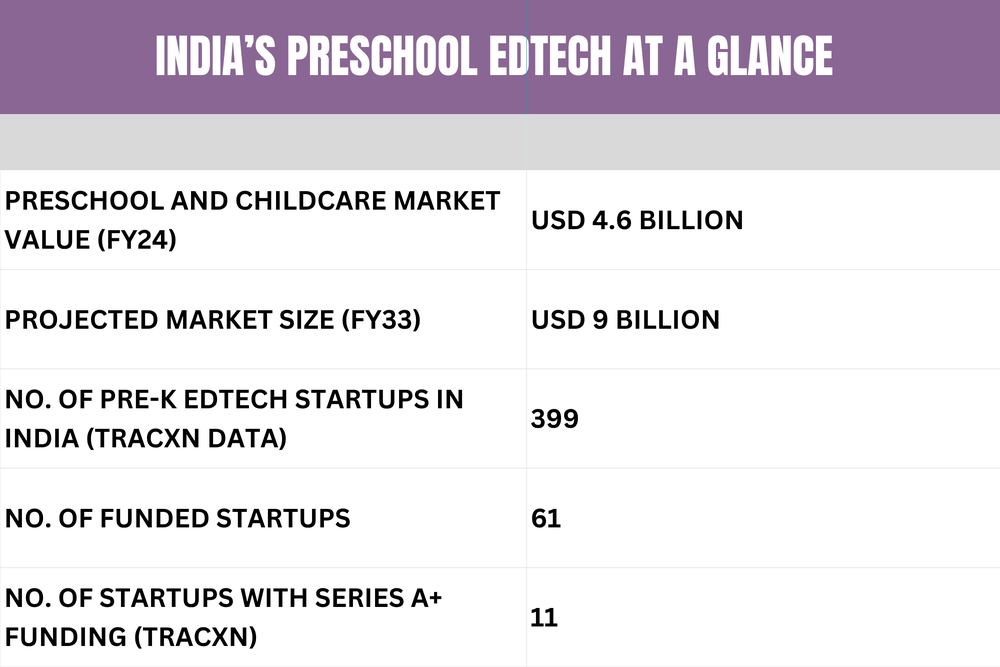
Investor Confidence vs Funding Gaps
Despite visible consumer demand in the early age edtech segment, investors remain cautious.
As Amit Agarwal, startup advisor and angel investor, who also developed Ocky Pocky, an early-age edtech platform, explained, "Early-age education is a sector that's easily monetizable but not easily VC-fundable, and I don't see that changing immediately. Early learning tech in India tends to be very local as parents prefer offline, low-screen solutions, and scaling that is inherently difficult. Digital-first models face resistance because parents are conscious about screen time and can't always monitor their children's engagement. While angel or seed rounds might happen, raising larger venture funding will remain tough until the market matures and demonstrates sustainable growth."
This caution reflects broader funding patterns. Since the 2021 edtech high, overall funding in the sector has contracted sharply, and early-age learning ventures have been hit harder. Investors cite limited scalability, high acquisition costs, and deep parental involvement as key friction points.
How Startups are Adapting
For founders in the space, however, demand continues to rise, and the focus has shifted to responsible innovation.
Devvaki Aggarwal, Founder and CEO of Instrucko, an online learning platform for kids, says the boom in early edtech is driven by "three powerful forces."
"First, there's parental aspiration: families now want their children to not just be academically competent but confident communicators, creative thinkers, and emotionally intelligent individuals from a young age. Second, accessibility has transformed the landscape; digital access has made structured early learning available beyond major metros, tapping into tier-2 and tier-3 markets. And third, parents want to give their children access to foreign languages and choose platforms that hold accountability for delivering learning outcomes."
To meet these expectations, platforms are focusing on personalized learning and AI-driven tracking to measure progress. "Children study best through a live personalized class, which is what Instrucko specializes in," Aggarwal says.
Devvaki adds that safety and screen balance are central to their pedagogy. "Safety and age-appropriateness are embedded into the design with controlled screen-time, parent dashboards, and secure platforms," she explains.
Screen-Time Dilemma
The debate around screen exposure continues to define the sector. Both UNICEF and WHO recommend no screen time for infants and only limited, supervised use for children aged 2-5, a stance echoed by Raj Singhal, Co-founder and CEO of Footprints Preschool & Daycare.
"The primary challenge for very young learners is substituting sensorimotor play and human interaction with sedentary screen time; WHO and AAP recommend no screen time for children under one and about one hour of high-quality, adult-guided content for ages 2-5, which aligns with our screen-free classroom stance," says Singhal.
At Footprints, classrooms are deliberately screen-free. The company uses technology for parent communication and operational quality, not instruction. "Technology is used for effective parent communication, offering CCTV access with AI monitoring and daily logs. It is not used for direct child instruction," Singhal explains.
This "tech-around-the-child" model, he says, defines the right direction for early edtech. "The goal is to integrate technology in a way that supports hands-on, relationship-focused classroom environments," he adds.
Blended Learning and Real Outcomes
For digital-first platforms like Instrucko, a blended approach bridges the gap.
"There should be a blended learning approach, which is vital for any child's healthy development," says Aggarwal. "At Instrucko, we recommend parents to take 2-3 classes per week, and each lesson is between 30-40 minutes to ensure there's no overload and additional screen time."
The platform's lessons rely on storytelling, props, and gamified engagement to build focus and emotional intelligence. "Our stories are age-appropriate and focus on real-life topics to enhance emotional intelligence, critical thinking, and life skills," she adds.
As the sector matures, both founders and investors see partnerships and measurable outcomes as key to the next phase of growth.
"The future of early childhood edtech in India will be shaped by three key shifts: strategic partnerships, technology leadership, and outcome-driven models. Differentiation will come from how well you use tech to personalize, not just digitize," Aggarwal notes.
Meanwhile, Footprints focuses on transparency, safety, and educator training, rather than direct digital instruction. "The childcare sector is evolving, with an emphasis on 'tech-around-the-child' rather than 'tech-for-the-child'," Singhal says.
India's early-age edtech story isn't about replacing teachers with tablets; it's about startups finding responsible ways to complement early learning. With the preschool market projected to double by 2033, the opportunity is vast, but the expectations around safety, ethics, and outcomes are even greater.


