
India's New-Age Brands are Turning Mithai into Scalable D2C Ventures Leveraging online retail, modern logistics, and shifting consumer interests, new-age startups are rebranding mithai for modern consumers, turning it into a year-long business
Opinions expressed by Entrepreneur contributors are their own.
You're reading Entrepreneur India, an international franchise of Entrepreneur Media.

India's mithai business has been a hyper-local and mostly seasonal affair for a long time, sold in neighborhood shops and consumed mainly during festivals. But that's rapidly changing. A new wave of brands is transforming mithai from festive treats into year-round indulgences, building scalable, design-led direct-to-consumer (D2C) ventures around what was once a small, local trade.
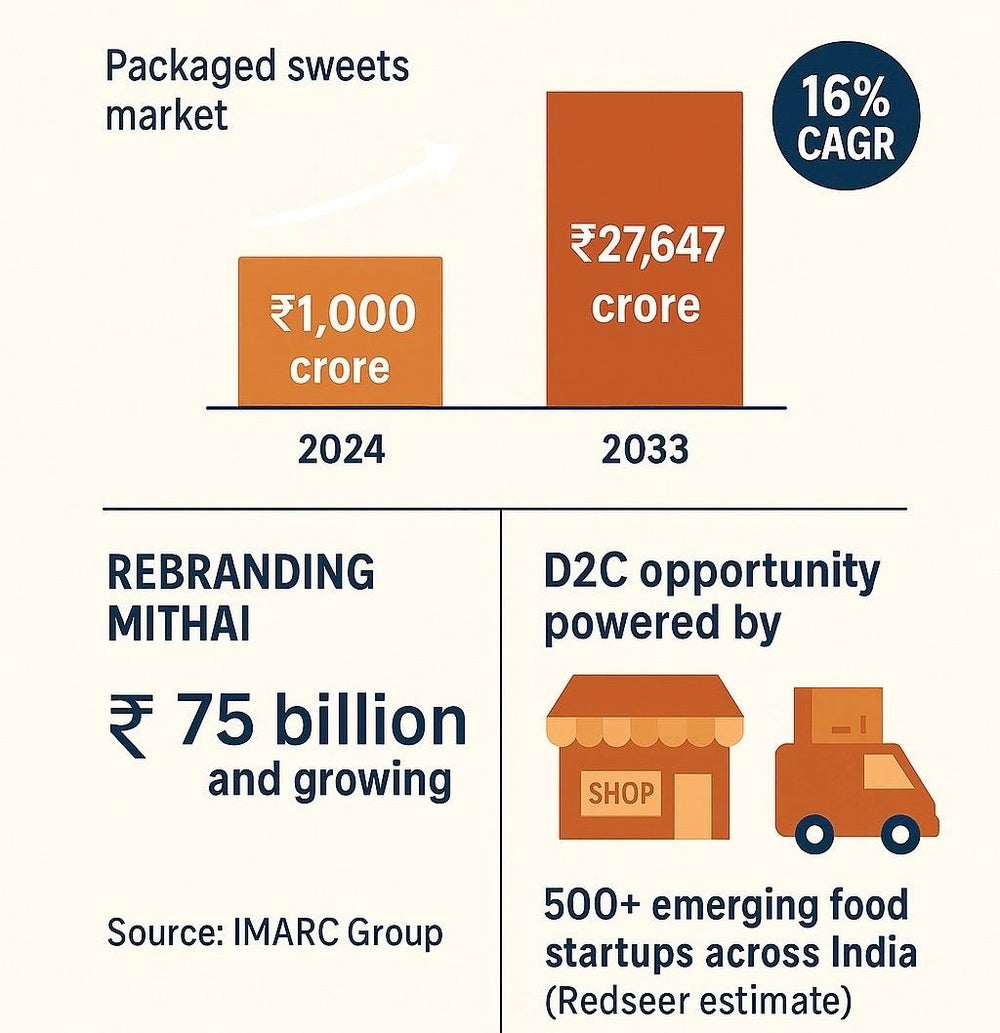
According to IMARC Group, the packaged sweets market in India was valued at INR 7,268 crore in 2024 and is projected to reach INR 27,647 crore by 2033, growing at a robust 16 per cent CAGR. What was once a seasonal business is now emerging as a year-round opportunity, powered by changing consumer habits, modern logistics, and storytelling-led branding.
Rebranding Mithai
New-age mithai brands are now focusing on artisanal, story-led product development to cater to a young audience while keeping the essence of traditional mithai.
At Bombay Sweet Shop, nostalgia meets innovation. "For too long, mithai had been boxed into just a festive category. We saw an opportunity to reinterpret it as a premium, everyday indulgence that could tap into global culinary trends," says Sameer Seth, Founder & CEO.
The brand's lineup includes inventive creations such as Coffee Rasgulla Tiramisu, Gulab Jamun Churros, and Jalebi Waffles. "We use traditional techniques and the finest ingredients, but also experiment with flavors like Biscoff, salted caramel, and matcha," he explains.
Storytelling and experience design are central to Bombay Sweet Shop's appeal. "Whether it's the ingredients we source or the reinterpretation of a classic recipe, we make sure every bite tells a story."
Other brands like KesarCo, Misree, and Arq Mithai are treading a similar path, combining premium packaging, clean ingredients, and bold experimentation to appeal to a generation that values both nostalgia and novelty.
Year-Round Indulgence
Another Mumbai-based brand, Hatti and Giraffe, was started by Shrikar Bhave and his wife Girija, inspired by his mother's traditional sweets. What began as a small kitchen experiment has now grown into a design-forward mithai brand working to turn traditional sweets into a year-long indulgence rather than just festive treats.
"In our vegetarian household, sweets were central to every celebration. We wanted to create something that didn't challenge tradition for novelty's sake but used contemporary design and technology to highlight it," Bhave recalled.
From their first product, the anti‐dessert laadu made with dried fruits, nuts, and edible gum, to almond thins and cranberry-walnut cubes designed for daily snacking, the brand's focus has been on weaving mithai into everyday life. "Traditionally, sweets were bought only during festivals. But that is changing with brands like ours," he adds.
The brand also consciously avoids chasing festive demand. "We don't only do festive specials; instead, we take time, sometimes a year or more, to develop each product. People now carry our tins while travelling, eat them with coffee, or gift them abroad. That helps break the seasonality that defined the mithai business," he said.
As Ankita Balotia, Vice President, Fireside Ventures pointed out, "Mithai is now an everyday indulgence over a festive indulgence, with 74 per cent of urban households consuming sweets multiple times a month as disposable incomes rise." This growing frequency of consumption is also pushing consumers to look for "healthier options like low-sugar, natural, or high-fiber variants," creating new opportunities for clean-label, portion-controlled innovations.
Supply Chain Behind India's Mithai Boom
From a business standpoint, direct-to-consumer (D2C) models, modern logistics, and shifting consumer interest have become the key enablers for scaling what was once a hyper-local industry. By selling directly to customers through online platforms instead of relying solely on local counters, mithai brands are tapping into national and even global demand, reshaping how sweets are made, stored, and delivered.
Bhave, who ships globally from his Mumbai base, said that each of their products is made to order and shipped the same day, a model that prioritizes freshness and control.
"People can now order from anywhere, anytime. We don't use modified atmosphere packaging because it compromises taste and texture. Even our international shipments use the same packaging as local deliveries," he adds.
Meanwhile, Bombay Sweet Shop has invested heavily in temperature-controlled logistics and Modified Atmosphere Packaging (MAP) to maintain freshness while scaling nationally. The brand now operates 17+ dark stores and delivery kitchens across Mumbai.
"Scaling a perishable product like mithai is no small task, but by combining technology with storytelling, we've built a model that can grow sustainably," explained Sameer Seth.
Balancing Tradition and Innovation
While the growth potential is immense, scaling mithai presents unique challenges, from perishability to maintaining authenticity. Bhave says being selective about the product line was key to staying viable. "We don't make many milk-based sweets because they have a shorter shelf life. Most of ours last 15 to 30 days without refrigeration," he notes.
Both founders agree that innovation must serve tradition, not overshadow it. "If you close your eyes and taste our sweets, the soul of traditional mithai should still be recognizable," Bhave emphasizes.
Seth echoed this statement, adding, "We're constantly pushing boundaries, but the soul of mithai remains unchanged. That's what makes it timeless."
As the category formalizes, Balotia believes "digital reach and evolving formats look to boost mithai into the same inflection point that dairy and coffee reached in recent years." She adds that for investors, "solving for shelf-life, better-for-you formats (portion control, sugar alternatives like dates) and giving it a modern look can be some of the factors that will make it an exciting investment case."
Investors added that consumer preference is highly variable when it comes to food products, but for startups, it boils down to product development and strategy.
Apurva Dixit, Vice President, Investments at Blume VC, said, "Both distribution and consumer preferences are changing rapidly. I've seen how fast younger brands scale compared to even five years back. Today when you think retail, you're thinking omnichannel — offline stores, ecom, quick com all simultaneously. From an investor lens, what makes it investible is when founders understand this complexity. What matters is how they approach it.".
India's evolving consumer base is driving this change. As Redseer's D2C reports highlight, younger consumers increasingly seek products that combine authenticity, health consciousness, and design-led storytelling, precisely what brands like these are offering. The country's INR 75 billion gifting market adds further fuel to the demand for well-packaged, premium mithai that travels well and fits into global lifestyles.


