This Buzzy Platform Is Becoming the ‘Spotify of Events’ — Here’s How
The events platform continues to evolve, twenty years in.

Courtesy of Eventbrite
This story appears in the November 2025 issue of Entrepreneur. Subscribe »
If you want to build a great business, look for an unsolved problem that’s newly solvable.
Two decades ago, that’s what the cofounders of Eventbrite saw. Many people wanted to host events, but selling tickets had always been complicated. Then, two changes emerged: Social media enabled communities to form and organize events. And financial services companies like PayPal enabled micro-transactions in a way previously unimagined.
Eventbrite was built to bring it all together. “We wanted to combine the power of micro-transactions with the creative brilliance of community organization,” says Eventbrite CEO Julia Hartz, one of the company’s three cofounders.
Related: Not All Problems Are Fixable — Here’s How Great Leaders Know What to Solve and What to Learn From
The company officially turns 20 in January, and a lot has changed. Eventbrite is a public company, awash in competition, and is actively evolving — working to find even more unsolved problems that are newly solvable. Instead of simply being a ticket sales platform, it’s expanded to become an event discovery platform. Hartz explains how they’ve kept the company relevant so long.
Twenty years is a big milestone. How are you feeling right now?
I’m feeling sentimental. And I’ve been thinking about how post-IPO, post-once-every-hundred-years-pandemic, post different changes that we made to our product, there were a lot of would-be “endings” in there that we saw as opportunities. They forced us to clarify what really matters. And recently, we’ve been using this analogy of Eventbrite becoming “the Spotify for events” — which, kudos to them, because the analogy instantly sticks for people.
What inspired that comparison?
We had become, essentially, an infrastructure for creators. They come to Eventbrite, they publish their event, they bring their attendee list; they invite their community — and that community transacts on Eventbrite. But midway through our existence, we realized: Wow, we’ve amassed hundreds of millions of consumers looking for things to do, and we don’t always have the right answer for them.
Whether it was on Eventbrite or through social media, people weren’t discovering events. They were stumbling upon them. How many times have you felt like, Oh, I wish I would’ve known that show was coming to town? So we found a missed opportunity in the experience economy: Discovery is broken.
When I think of events, I tend to think of a band telling me about their show. But what you’re describing is actually a completely separate user: It’s someone just searching for something to do.
We really started to focus on what I would call the “Social Scout”: someone who is innately curious, who always knows the best new restaurant or best drink at a bar, who prides themselves on knowing what’s going on. And we thought about building a solution for this type of person.
It was less about structured data — I mean, there was a point at which I thought for sure if we could access [the events on] your calendar, we could nail it. But that’s not it at all, actually. Spotify didn’t win by helping you find the songs that you already knew, right? It doesn’t ask you what you want. Spotify won by learning your tastes and recommending the right songs at the right moment. And that’s what’s inspiring to us. Our bet is that the next billion attendees aren’t searching. They’re discovering.
Related: Why Marketing Savvy is the Important Attribute of Successful Entrepreneurs
So how do you go about serving that new kind of user?
Here’s the way we’re thinking about it: Every time someone is looking for an event, whether it’s on or off Eventbrite, they should be able to easily find great things to do through the Eventbrite source — which means making sure that we can put the right event in front of the right person at the right time, literally wherever they are.
We’ve never been super precious about it having to happen on Eventbrite. That’s our first principle. Discovery is happening through contextual media. So we’ve built APIs and distribution partnerships with people like Spotify that allow for the contextual discovery to happen. If you’re listening to an artist, and that artist is coming to town and their show is on Eventbrite, you’ll be able to buy tickets without leaving that experience. That’s the end goal. We started this way back when, with Facebook, and have expanded to TikTok and other social media distribution platforms.
Now here’s the second thing: When people log into the Eventbrite consumer app, our recommendations are a bull’s-eye for them. We’ve always thought we could leverage technology to make connection easier and faster and more effective. We know what they might be interested in based on past events they attended, where their friends are going, what’s trending in their area, and so on.
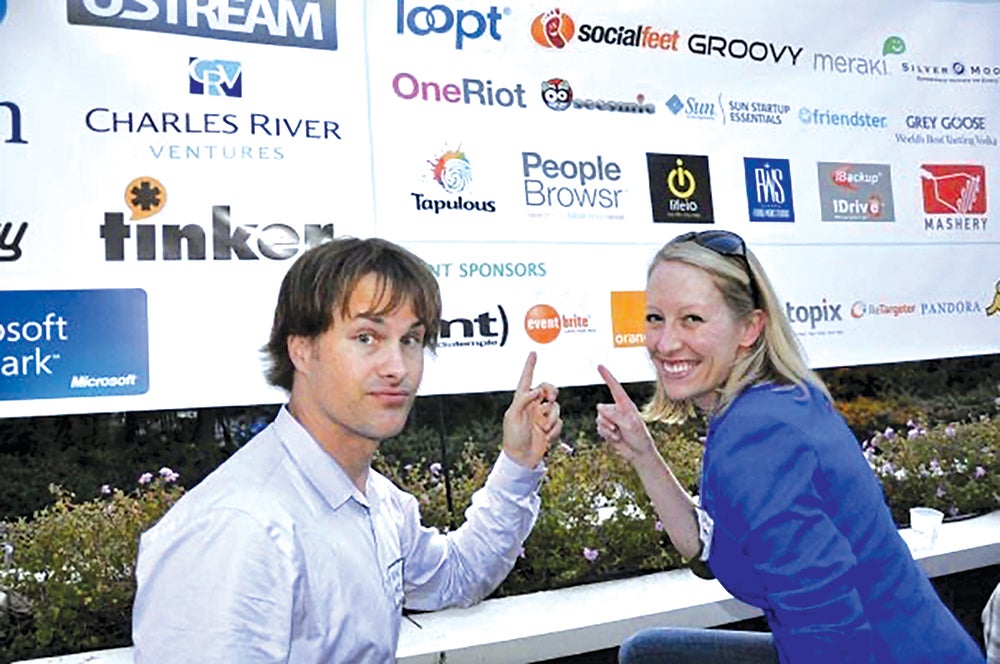
Julia Hartz, with cofounder Kevin Hartz, spotting their logo in Eventbrite’s early days.
Image Credit: Courtesy of Eventbrite
And if you can reach the Social Scout, they’re likely to bring other people along with them, right? They bring more customers into Eventbrite.
Event creators are our heroes. It’s one of the most stressful careers you could possibly choose. When we think about the logistics of creating an event and breaking down the value loop for an event, every single additional attendee that we can lock in for the creator is massively valuable for them.
Most events have a fixed cost of the venue and the performers and the vendors, so the creator’s just hoping to clear that fixed cost. So we realized that if we could provide incremental value to each creator by helping them reach a bigger audience, that’s magical. That could be the difference between them being able to host another event or not.
It also could be the difference between them using Eventbrite or other platforms. Because now that you’ve been around 20 years, you’ve got competitors.
We have a lot of competitors. But about 23% of the tickets that are transacted on Eventbrite are driven by an action that Eventbrite uniquely took. We see power in that, but that’s not where we’re generating our value proposition. We’re really hoping that creators understand that if they stay with Eventbrite, they’re building their own compounding growth loop in audience, in community, in attendees, in people who are gonna tell other people about their event.
That’s where we really focus our product: on making sure that they understand who their most loyal customers are — where they came from, when they bought tickets, at what price — and really helping them understand the intelligence layer of that.
So Eventbrite is not just seeking out Social Scouts. You’re still developing the creator side, too.
Our job is to really help event creators understand, to a certain degree of precision, how we’re getting them audience members — to help them do that more. Very antithetical to most of our competitors, we don’t operate in a black box. We show creators exactly where that person came from, because we know that creators are entrepreneurial; they’re builders. We want them to be able to go out and be better marketers of their event. So we’re never going to hide our marketplace tactics or how we drove a person to an event. We’ll always try to teach them how to do it themselves.
Related: Why Meeting Consumer Expectations Won’t Cut It — and What Businesses Should Do Instead
If you want to build a great business, look for an unsolved problem that’s newly solvable.
Two decades ago, that’s what the cofounders of Eventbrite saw. Many people wanted to host events, but selling tickets had always been complicated. Then, two changes emerged: Social media enabled communities to form and organize events. And financial services companies like PayPal enabled micro-transactions in a way previously unimagined.
Eventbrite was built to bring it all together. “We wanted to combine the power of micro-transactions with the creative brilliance of community organization,” says Eventbrite CEO Julia Hartz, one of the company’s three cofounders.