
Trump's Tariff Gamble Faces Its Supreme Test: A $3 Trillion Bet That Could Rewrite Global Trade Rules The dispute traces back to April 2, 2025, when President Trump declared America's chronic trade deficit a "national emergency" and imposed 10% tariffs on nearly all imports, later raising them to as high as 50% on selected countries.
By Rajat Mishra
Opinions expressed by Entrepreneur contributors are their own.
You're reading Entrepreneur India, an international franchise of Entrepreneur Media.

1 First Street in Washington became the focal point of global attention on Wednesday. And why wouldn't it be? The U.S. Supreme Court, located on that very street, was hearing one of the most consequential trade cases in modern history. The outcome could redefine the limits of presidential power, recalibrate global trade, and—most significantly—potentially compel the U.S. Treasury to refund hundreds of billions of dollars already collected in import duties.
The hearing lasted three hours, with Trade Secretary Scott Bessent and Commerce Secretary Howard Lutnick in attendance. President Donald Trump, however, skipped the proceedings this time.
The nine justices are now weighing a single, monumental question: Did President Donald Trump overstep his constitutional authority by imposing sweeping tariffs under the 1977 International Emergency Economic Powers Act (IEEPA) without congressional approval?
"The outcome now will determine whether Donald Trump overstepped his powers when he invoked the International Emergency Economic Powers Act (IEEPA)—a 1977 national security law—to impose sweeping import tariffs under his 'Liberation Day' program," said Ajay Srivastava, Founder of the Global Trade Research Initiative.
The dispute traces back to April 2, 2025, when President Trump declared America's chronic trade deficit a "national emergency" and imposed 10% tariffs on nearly all imports, later raising them to as high as 50% on selected countries. The administration argued that decades of trade deficits had weakened the U.S. industrial base and posed an economic threat. Critics, however, called the move unprecedented, noting that the U.S. has run trade deficits since 1975 without declaring such an emergency.
The Law at the Core of the Fight
At the heart of the case lies the International Emergency Economic Powers Act (IEEPA)—a 1977 law that empowers the U.S. president to regulate commerce during a declared national emergency. No previous president, however, has invoked it to this extent. Trump became the first to use IEEPA in response to soaring trade deficits, which he argued amounted to an economic emergency.
Why It Matters for India
For India, one of the nations hit with the steepest tariff rates—up to 50%—the stakes are unusually high. With U.S. exports already falling 12% in September, New Delhi finds itself at a crossroads: trying to boost exports while managing the fallout from these tariffs.
Two scenarios could unfold for India.
- If the Supreme Court strikes down the tariffs, India could regain negotiating space in ongoing trade talks.
- If Trump wins the case, he would gain virtually unchecked authority to deploy tariffs as a foreign policy weapon—placing sustained pressure on Indian exporters.
By the Numbers
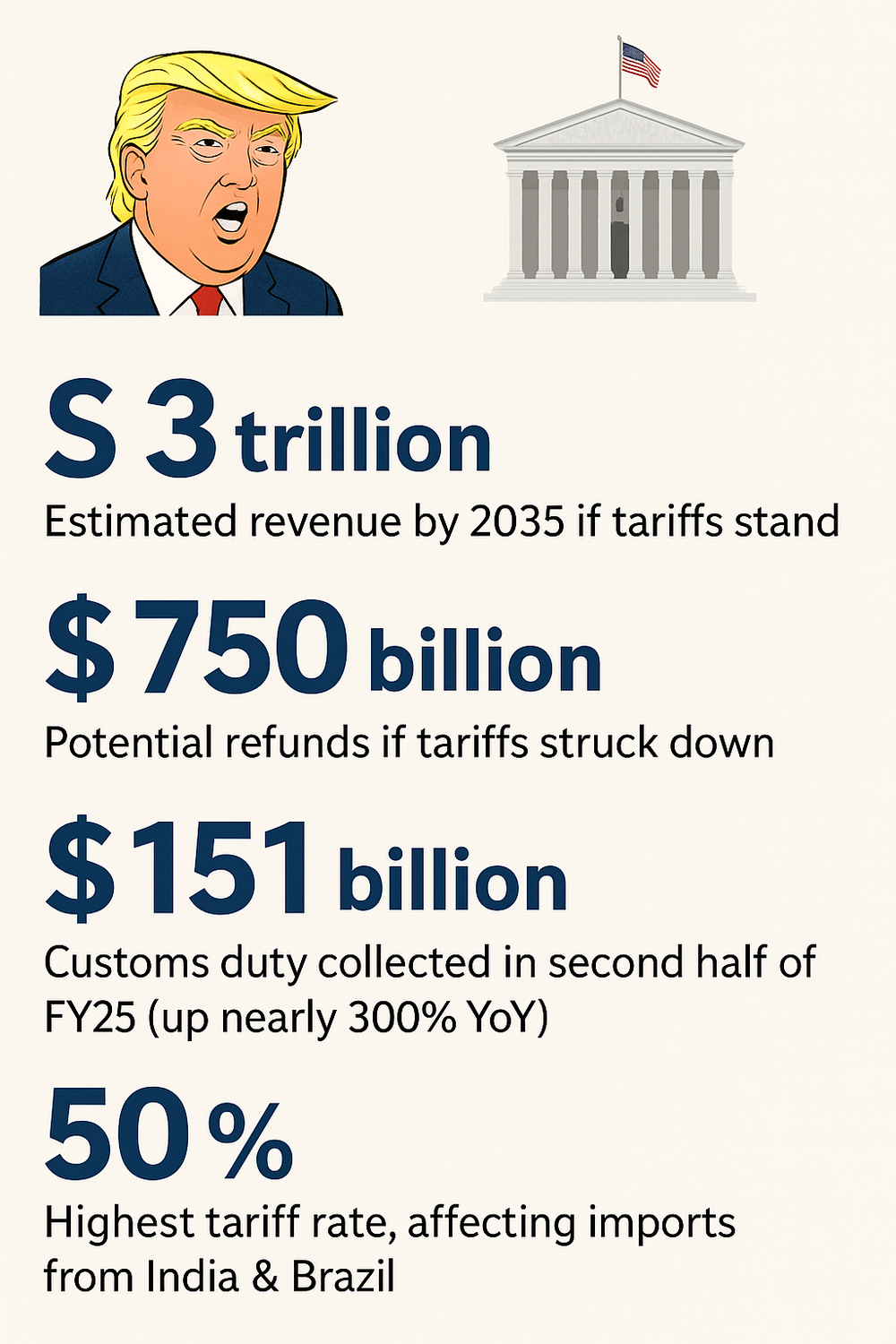
- $3 trillion – Estimated revenue by 2035 if tariffs stand
- $750 billion – Potential refunds if tariffs are struck down
- $151 billion – Customs duty collected in the second half of FY25 (up nearly 300% YoY)
- $90 billion – Import taxes already paid under IEEPA tariffs
- 50% – Highest tariff rate, impacting imports from India and Brazil
- 12 states – Challenging the legality of Trump's move
If Trump Loses: A Fiscal and Diplomatic Earthquake
"A ruling against Trump would mean every 'Liberation Day' tariff — and the subsequent rate hikes — lack a lawful basis," said Ajay Srivastava.
If Trump loses, his administration could be forced to roll back tariffs or face injunctions halting their collection—delivering a serious blow to U.S. fiscal planning and undermining his negotiating leverage.
Srivastava notes that even if the administration pivots to alternative trade authorities—such as Section 301 of the Trade Act of 1974 (for unfair trade practices) or Section 232 of the Trade Expansion Act of 1962 (for national security)—each would require new investigations, hearings, and justifications.
"It would slow down the U.S. trade policy machinery and reopen the door for Congress to reassert control," Srivastava said.
A PwC Global Trade Report calls this case "a turning point for U.S. tariff diplomacy."
"If IEEPA is struck down, it will reassert Congress's primacy in trade policy and sharply curb presidential latitude to weaponize tariffs," PwC noted.
"Beyond U.S. borders, the ripple effects would be profound — unwinding several trade arrangements struck under the shadow of those tariffs."
According to PwC, the verdict could upend trade agreements with the EU, Japan, South Korea, and the UK, all negotiated amid implicit threats of higher tariffs.
A Global Domino Effect
According to Wells Fargo estimates, roughly $90 billion in import taxes have already been collected under the contested regime. If the court delays its ruling until June, that figure could balloon to $1 trillion.
Politically, the timing couldn't be more explosive. A decision against Trump would arrive just months before the 2026 presidential primaries, potentially reigniting debates over executive overreach, global trade fairness, and America's economic identity.


