
Dark Patterns Return to Spotlight Amid Compliance Indifference Consumer Affairs Minister Pralhad Joshi last week said that the firms charging extra on cash-on-delivery will face action from the government.
By Kul Bhushan
Opinions expressed by Entrepreneur contributors are their own.
You're reading Entrepreneur India, an international franchise of Entrepreneur Media.

India's digital economy, worth USD 402 billion, is battling a new challenge for some time - transparency.
Evidently, Indians are embracing the digital economy, including ecommerce, quick commerce, and other internet-based services but at the same time, they are also dealing with the so-called 'dark patterns' deployed by these companies.
Dark pattern in this context is essentially aimed at subverting a consumer's autonomy and informed decisions, causing the customer to pay more than the price they see. It is also tricking users into giving away more personal data than needed or simply making them sign up or pay for something.
Over the last couple of years, a lot of companies have been found practicing some of these dark patterns.
Earlier this year, the Central Consumer Protection Authority (CCPA) issued notices to Ola and Uber, the two major online ride hailing platforms, for unfair trade practices and violation of consumer rights.
The notice also mentioned "lack of any information on the algorithm or method used by the company to charge different fares for the same route from two individuals" as well as "inclusion of charges for add-on services by pre-ticked boxes for including add-on services without obtaining consent by explicit and affirmative action before each ride."
Moreover, social media is awash with posts that highlight such instances where certain quick commerce companies and ecommerce firms were allegedly using such practices. This includes, as mentioned above, differential prices based on the kind of devices (iPhone and Android) customers use.
Why is the dark pattern back in the spotlight?
Responding to a user's tweet, Consumer Affairs Minister Pralhad Joshi last week said that the firms charging extra on cash-on-delivery will face action from the government. The user had posted a photo of a receipt that featured a rather intriguing 'total fee' which consisted of three elements namely (other handling fees and protect money fee).
The post read: "Forget Rain Fee by Zomato/Swiggy/Zepto. See the masterstroke by Flipkart: Offer Handling Fee (for giving me the discount you advertised??); Payment Handling Fee (for letting me pay you??) and Protect Promise Fee (protecting me from what... satisfaction?),".
Promising an action to this, Joshi responded, "The Department of Consumer Affairs has received complaints against e-commerce platforms charging extra for Cash-on-Delivery, a practice classified as a dark pattern that misleads and exploits consumers."
"A detailed investigation has been initiated and steps are being taken to scrutinize these platforms closely. Strict action will be taken against those violating consumer rights to ensure transparency and uphold fair practices in India's growing e-commerce sector," he added.
Entrepreneur India has reached out to Flipkart for a comment. We will update the copy as soon as we hear from them.
Government's Stance, Regulatory Action, and its Effectiveness
So far, the government has taken a few steps to discourage the dark patterns online.
Apart from the notices, like the one mentioned above, the CCPA has also issued guidelines for the ecommerce sector. This includes "Guidelines for Prevention and Regulation of Dark Patterns, 2023" issued on November 30, 2023.
Earlier this year, "Advisory in terms of Consumer Protection Act,2019 on Self-Audit by E-Commerce Platforms for detecting the Dark Patterns on their platforms to create a fair, ethical and consumer centric digital ecosystem" was issued.
"All E-Commerce platforms have been advised through the said Advisory to take necessary steps to ensure that their platforms do not engage in such deceptive and unfair trade practices which are in the nature of Dark Patterns. Further, all E-Commerce platforms have been advised to conduct self-audits to identify dark patterns, within three months of the issue of the advisory and take necessary steps to ensure that their platforms are free from such dark patterns," said a note following a meeting between consumer affairs ministry, food and public distribution, and e-commerce companies, industry associations, and other stakeholders.
"Based on the self-audit reports, the E-Commerce platforms should also give self-declarations that their platform is not indulging in any dark patterns in order to ensure a fair digital ecosystem along with building trust between consumers and e-commerce platforms."
It's worth noting that under the Consumer Protection Act, 2019, violations can attract penalties, including fines up to INR 20 lakh and imprisonment up to six months. However, there seems to be little let up in the use of dark patterns by apps and online platforms be it travel, hospitality, banking and insurance or ecommerce.
A recent study by LocalCircles reveals that Digital Lending, Travel, Airlines, ecommerce, Quick Commerce, Online Banking & Payments, Taxi and OTT platforms have among the highest number of dark patterns.
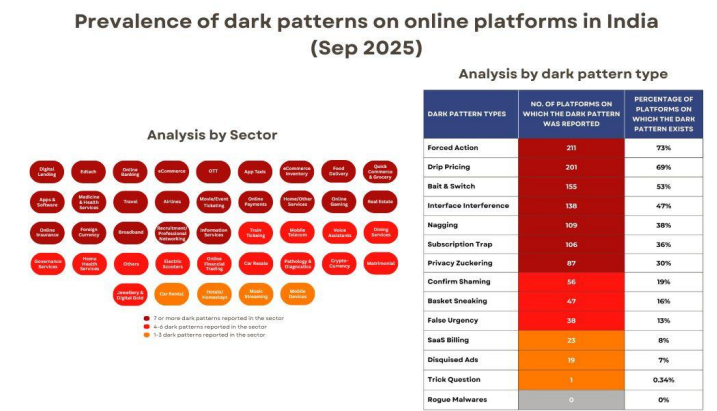
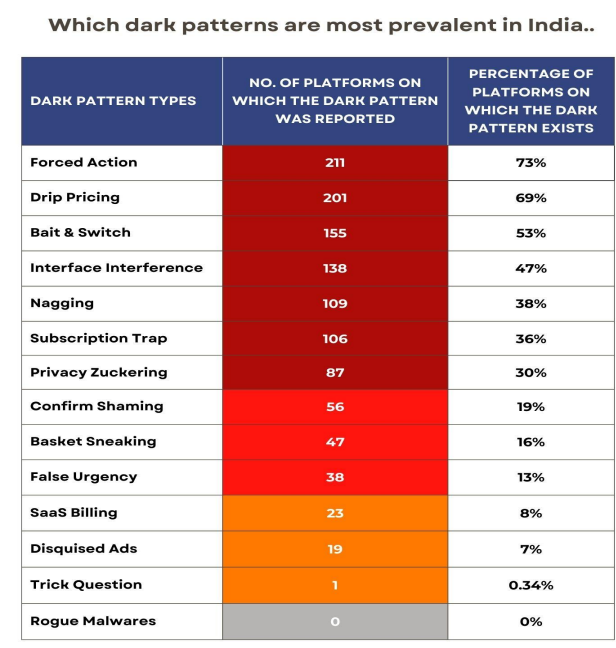
The study further reveals that over 1 in 2 online platforms use Forced Action, Drip Pricing and Bait & Switch dark patterns.
"...among most used dark patterns Forced Action tops the list with 211 or 73% of platforms using it; 201 platforms or 69% have been found to use Drip Pricing; 155 platforms or 53% have been found to use Bait & Switch; 138 platforms or 47% have been found to use Interface Interference; 109 platforms or 38% have been found to use Nagging tactics; 106 platforms or 36% have been found to use Subscription Trap; 87 platforms or 30% have been found to be using Privacy Zuckering, a dark pattern not yet specifically identified by the CCPA but will still qualify as an unfair trade practice," it noted.
The study also observes that 22 months after the CCPA notified 13 dark patterns and asked online entities to desist from using them, there appears to be limited impact of the government advisories and call to action with just 3% platforms in India being free of dark patterns. While some platforms have addressed a few of their dark patterns in the last 3 months, the majority have ignored the CCPA advisories, the study added.
Intense Competition, Brand Loyalty, And Need For Transparency
There's a consensus that companies should practice transparency. For instance, if an online company does explicitly mention that it will levy certain charges for delivery or anything else, and yet the customer goes ahead with the purchase, it's unlikely that it will be considered a dark practice.
Though, things like differential pricing based on user's devices or profiles seem like a loophole that may go unnoticed by an individual before completing a transaction.
LocalCircles cofounder Sachin Taparia adds that all platforms that currently have the Drip Pricing dark pattern must ensure that all add on charges are disclosed upfront on the product selection screen to be dark patterns free and ensure no charge is sneaked in at the last step to become free of Drip Pricing.
Taparia adds that while regulations are sufficient to curb such practices but needs better implementation.
As far as ecommerce and other players in the digital economy go, more transparency may lead to a short-term revenue loss. But in the long run, as Taparia, points out these firms will earn consumer trust and brand loyalty.
Meher Patel, founder of Hector, an adtech platform that works closely with ecommerce and quick commerce companies, points out that ecommerce platforms operate under constant margin pressure and competitive intensity.
Profitability varies widely across products, logistics models, and payment modes. For example, prepaid orders are cheaper to process, while cash-on-delivery orders incur higher handling and cancellation costs.
To manage these variables, companies often structure prices dynamically or distribute certain operational costs across product listings. This helps them stay competitive while maintaining service levels.
"From a psychological standpoint, certain pricing approaches such as rounded prices, "free shipping" thresholds, or limited-time offers are designed to simplify decision-making and reduce hesitation. These tactics are not inherently misleading; they reflect an effort to align pricing presentation with how consumers naturally evaluate value," Patel said.
He, however, also stressed the need for maintaining clarity without overwhelming the customer.
"Platforms that disclose all costs transparently while keeping the user experience simple tend to build deeper, more lasting trust," the Hector founder added.
Chirag Taneja, Gokwik cofounder and CEO, tells Entrepreneur India that a lot of such practices stem from competitive pressure and behavioral economics, not necessarily from intent to deceive.
"E-commerce operates in an incredibly competitive environment — every click, discount, and delivery promise matters. Many brands adopt psychological cues like limited-time deals or partitioned pricing to stand out. These are rooted in cognitive science — consumers are more likely to act when they perceive a deal or when the "pain of paying" feels delayed," Taneja said.
Taneja also stressed on the need for transparency and building long-term trust.
"... When a brand takes the time to explain its pricing — whether it's due to sustainable sourcing, local manufacturing, or better quality control — customers respond with trust, not resistance. In a world of constant offers and price wars, being transparent is becoming a brand strategy in itself. The best D2C brands are realising that honesty and storytelling build far deeper loyalty than a flash discount ever can," Taneja added.


