
Can Smart Rings Disrupt Digital Payments in India? Muse Wearables is Taking a Shot Part of the IIT Madras Incubation Cell, Muse Wearables teams up with NPCI to bring digital payments through smart ring.
By Kul Bhushan
Opinions expressed by Entrepreneur contributors are their own.
You're reading Entrepreneur India, an international franchise of Entrepreneur Media.

Beyond health tracking, what else can you do with a smart ring? Payment? Yes.
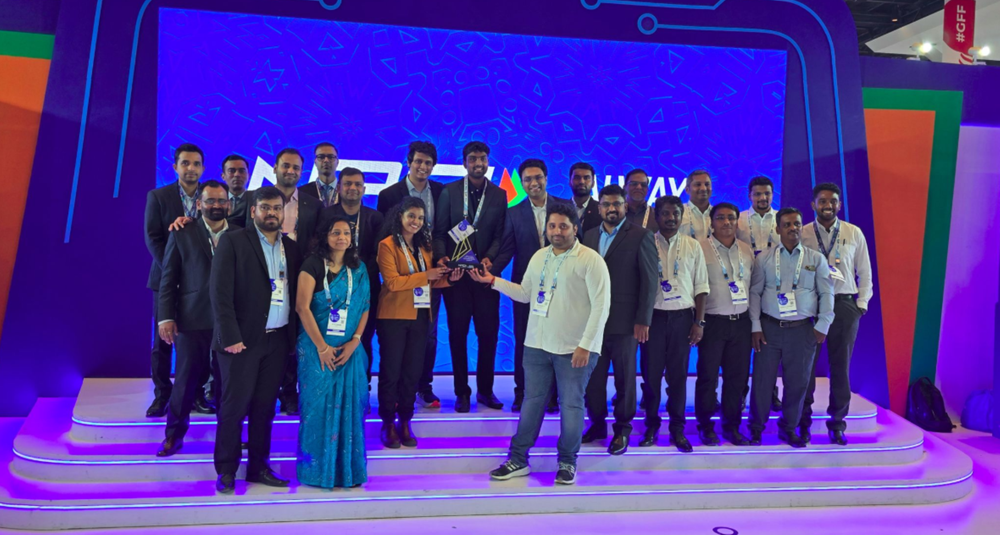
Muse Wearables, a Bengaluru-based startup, earlier this week announced that they had teamed up with the National Payments Corporation of India (NPCI) to launch what the company describes as India's first wearable payments ecosystem.
The so-called ecosystem is powered by Muse Wallet and NPCI's RuPay network. Essentially, users of Muse Wearables' smart ring, dubbed Ring One, can make secure payments by tapping the device on any NFC-enabled POS terminal.
The startup claims that the service is already available in more than 40 countries and supports cards from nearly 600 banks, and now the Wallet is being brought to India via RuPay.
"Muse isn't competing within the mobile ecosystem, we're building what comes next. While most payment platforms focus on apps and smartphones, we're pioneering the next generation of personal computing, where technology moves from the phone to the human body," KLN Sai Prasanth, CEO & cofounder at Muse Wearables, tells Entrepreneur India.
Origins
Muse Wearables' origins begin in 2016 with founders Prasanth and Yathindra Ajay KA, graduates of IIT Madras, and K Prathyusha, an NIT Warangal Graduate, along with the IIT Madras Incubation Cell.
Initially, the company built hybrid smartwatches. In 2017, its 'Muse Hybrid SmartWatch' went through Proof Of Concept, Design ideations, Design Validation and Iterations as well as raised funds in an angel round to commercialise the product.
One year later, the company launched a crowdfunding campaign on Kickstarter and in less than a month it got the attention of around 700 allies from 60+ nations worldwide. In 2019, it started delivering products to people who backed the crowdsourcing campaign on Kickstarter and Indiegogo, and also introduced MusePay service in more than 27 countries.
"Our journey began with smartwatches, as they were the natural entry point into consumer tech and health tracking. While developing wrist-based sensing, we discovered that the ring form factor delivers superior signal quality for capturing vitals like heart rate and blood pressure — being closer to the arteries and less prone to motion noise," the cofounder said.
Prasanth adds that Muse Wearables was born out of a clear gap that is India did not have a deep-tech consumer electronics company building world-class products that could compete globally.
"For years, most innovation came from outside India, while our contribution was limited to software or assembly. We wanted to change that, to build a truly Indian company that leads the next wave of personal technology from design to manufacturing," he said.
His team focused on building products that could reduce daily friction and increase human potential, technology that works silently in the background and simplifies life.
He highlighted that the Ring One also provides cuffless blood pressure monitoring and other fundamental smart health features such as heart rate, HRV, SpO₂, temperature, exercise, mindfulness and sleep tracking.
Muse Wallet: The Secret Sauce
Even as the Ring One is the hardware, the core of the payment system is the Muse Wallet, which the company says is India's first secure element tokenization platform that supports tokenization of debit, credit and prepaid cards.
How it works:
Users add their RuPay card in the Muse App — either by scanning or manual entry.
Muse Wallet communicates with the Rupay card network and the issuer bank to generate a unique token for that card.
The token is securely transmitted to the Secure Element inside Ring One, where it is encrypted and stored.
When the ring is tapped at an NFC terminal, the Secure Element executes the transaction without ever exposing the actual card number.
This hardware-level isolation makes Muse Wallet a new benchmark for wearable security in India.
Muse says that the payments work only when the ring is worn and removing it, instantly disables transactions. If the ring is lost or stolen, the token remains inert and useless without the authenticated context.
Under the hood
Prasanth highlights that the entire tokenization and provisioning infrastructure are built from the ground up, compliant with PCI DSS and EMVCo global security standards, and deeply integrated with multiple global card networks.
This essentially enables any Muse wearable to instantly convert a physical card into a secure digital token stored directly inside a tamper-proof Secure Element (SE) chip.
At the hardware level, the company has patented a custom NFC antenna design that enables both wireless charging and contactless payments inside a ring, a world-first engineering achievement.
It has also developed biometric sensing algorithms for on-body authentication and a proprietary encryption layer for dynamic key management. This added security ensures that no one except the user can make payments with their ring.
Business strategy and competition
Are smart rings here to replace the familiar UPI-driven apps like Google Pay or Paytm?
Muse founder makes it clear that their product/service is not targeting the mobile ecosystem, but trying to build what would be the next natural evolution. He notes that most payment platforms focus on apps and smartphones.
Asked about the competition with the likes of Apple and Samsung, which too have a strong portfolio of wearable tech and services, Prasanth notes that these two tech giants have their own limitations.
"Global players like Apple and Samsung use Secure Element (SE) tokenization, but their payment systems are still limited to their own device categories. Apple doesn't offer payments through a smart ring, and Samsung doesn't yet have the technology to enable secure, hardware-level ring payments. Muse is introducing a new form factor that people love, while entering markets and categories where Apple and Samsung aren't fully available," he tells Entrepreneur India.
Similarly, for local fintech firms, he said they are mobile-first whereas Muse is tapping into the wearable technology.
Muse founder is also confident that the new form factors such as smart ring could pave the way for the revival of card-based revenue streams for banks. It's worth noting that a large chunk of this revenue has been cut by the massive UPI adoption. This is where Muse sees an opportunity as it plans to add up to 20 more banking partners in the next year. Even as the tokenization is being provided to banking partners for free for now, the company is considering a commercial model once it's able to up the volume.
As of now, the company's primary revenue is coming from a B2C model, which is essentially selling the smart ring. Though, the long-term plans include transitioning into a B2B performance-based revenue model given the ecosystem adoption and scale. It aims to hit USD 100 million ARR within the next 18-24 months.
As mentioned above, the company operates globally with an ambition to expand deeper into North America, Europe, the Middle East, and Asia-Pacific regions.
The smart ring currently retails for USD 349 (nearly INR 30,700). The company will announce the India retail price in January next year.
Smart Rings in India, UPI, and more
As of now, smart rings seem more like a novelty than necessity. But we have seen enough brands, products, and services transition from novelty to being used by everyday people. And at the same time, we have seen some concepts never taking off.
As far as form factors go, we have seen brands making efforts to try something new. Back in the day, brands experimented with 3D phones, projectors, and even modular phones. Even as Ray-Ban Meta Glasses are all rage now, Google failed to win with its Google Glass at least a decade ago. However, newer concepts such as foldable phones and smartwatches have taken off with the masses.
While Muse is focused on card-based networks as of now, India's favourite payment mode, UPI, is now opening up to newer technologies.
Just recently, a new pilot started by Razorpay, NPCI, and OpenAI, and backed by banking partners Axis Bank and Airtel Payments Bank, allows users to make orders from BigBasket via ChatGPT in a familiar conversational style.
Moreover, UPI is opening up to add compatibility with Internet of Things such as connected cars and smartwatches. Smart rings seem like a plausible addition to this suite.
Muse's ambitions are commendable, and it's certainly positive to have another Indian deep-tech brand explore global markets. The likes of Ultrahuman have also done the same to some extent in this space.
Just to put things into perspective, the medical smart rings market in India is forecasted to reach a projected revenue of USD 74.3 million by 2030, according to a report by GrandView Horizon.
However, smart rings are definitely going to compete with the conventional way of digital payments including UPI. The category itself will have to evolve into something that ensures ease of use and security and trust. The market awaits the verdict.


