
Breaking Down Agentic Payments, UPI's AI Moment, And More Razorpay, NPCI, and OpenAI partner to test Agentic Payments within ChatGPT in India.
By Kul Bhushan
Opinions expressed by Entrepreneur contributors are their own.
You're reading Entrepreneur India, an international franchise of Entrepreneur Media.

Soon, you may be able to order groceries and shop for other items from ChatGPT, and even let the AI make the payments for them.
This rides on the success of a new pilot started by Razorpay, National Payments Corporation of India (NPCI), and OpenAI, and backed by banking partners Axis Bank and Airtel Payments Bank. One of the first merchants to join the pilot is BigBasket, a Tata enterprise.
So, how will this work?
In a familiar conversational style, you can ask ChatGPT to order items from BigBasket. The AI agent will check the catalog, serve you some alternatives, and after your consent, it places the order via Razorpay's payments stack.
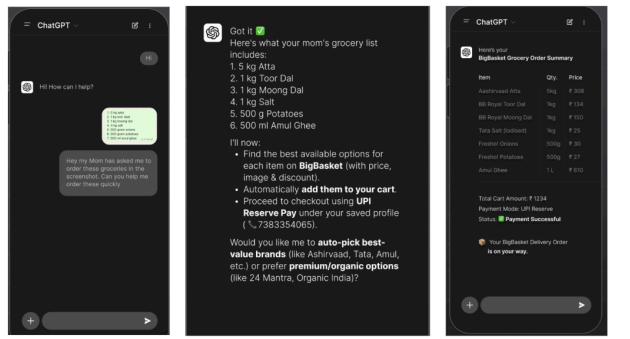
A joint release says that users remain in full control of the process and have access to features such as real-time tracking, among others.
Agentic payments
Agentic payments are essentially digital payments initiated and executed by an AI agent, needing minimal to no human intervention. These payments may not just be limited to one-time (akin to conventional ecommerce shopping experience) but also capable of making recurring payments, but slightly higher awareness.
The AI agent uses its intelligence to browse the best options, compare prices, and merchants once a user expresses intent for a specific product or service. The agent is also capable of showing the most suitable payment option based on users' predefined preference (could be compatible card, wallet and others) and real-time conditions.
The agents are also capable of initiating and completing a transaction without needing manual intervention, as mentioned above. Unlike the conventional autopay or scheduled payment systems, agentic AIs can make adjustments real-time through their contextual awareness, which is the main differentiating factor.
To put things into perspective, OpenAI last month rolled out "Instant Checkout and the Agentic Commerce Protocol" for its users.
The feature essentially allows users to directly buy items directly from ChatGPT. At the time of the launch, the feature supported single-time purchase. OpenAI then promised to add features like multi-item carts, and expand merchants and regions.
So, when a user looks for "best running shoes under USD 100", ChatGPT will browse the web to showcase the relevant product. If a product is compatible with Instant Checkout, users can tap "buy" and confirm their order (including shipping and payment details) without needing to exit the chat.
"ChatGPT simply acts as the user's AI agent—securely passing information between user and merchant, just like a digital personal shopper would," OpenAI explained in a blog post.
Under the hood, OpenAI's new shopping feature is powered by an 'agentic commerce protocol', which the company says, provides the language enabling AI agents and business to talk to each other to complete a purchase on behalf of a user.
The protocol is built in partnership with Stripe, allowing merchants to "work across platforms, payment processors, and business types; integrate quickly without changing their backend systems; keep merchants in control of the customer relationship as the merchant of record across the purchase journey–from fulfillment and returns to support and communication."
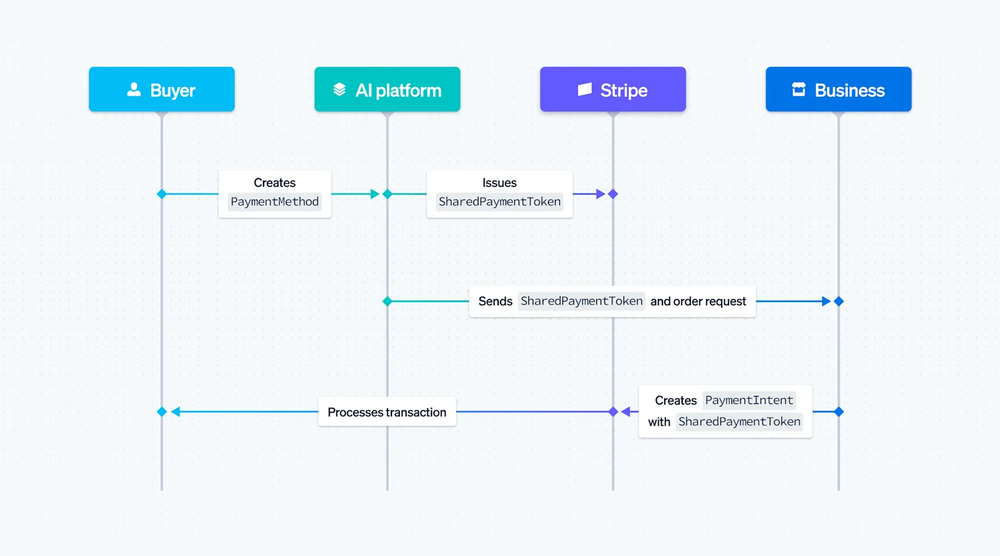
Separately, Stripe in a blog post explained that it has built a Shared Payment Tokens (SPT) which enables agents to start payments using a buyer's consent and preferred payment method, without exposing credentials.
UPI's AI moment
One of the key highlights of the pilot program is the UPI opening up to AI integration. And the success of the pilot could pave the way for new commerce and agentic use cases via UPI.
Earlier at the Global Fintech Festival 2025 in Mumbai, Governor of the Reserve Bank of India (RBI) Sanjay Malhotra, introduced new digital payment initiatives, including UPI Reserve Pay, which is pretty much the core of the payment process for the new pilot.
The feature essentially allows users to block a specific amount in their linked account or RuPay credit card and enable debits against the amount at a later stage, according to AngelOne. Funds are debited after confirmation of a transaction.
Potential impact on ecommerce
Ecommerce along with quick commerce have a massive presence in India. And in recent years, AI platforms like OpenAI, Gemini (Google), and Perplexity have gained massive popularity in the country.
In the case of OpenAI, India is now one of its biggest markets with nearly 111 million downloads since the launch. According to a CNBC report, Indians have spent USD 21.3 million on ChatGPT so far. Perplexity too has gained traction in the country with its partnership with Airtel where it is giving free access to users for a limited time.
Even as more users, especially a younger demographic, are getting familiar and comfortable with the AI platforms, shopping does not seem far-fetched. And it also shows the evolution of AIs moving from a basic browsing assistant to full-fledged transaction executor.
This is pretty similar to browsing items on Google, though now with NLP-driven prompts and probably contextual understanding.
In the past, we have seen ecommerce getting deeper integration with modern technology. For instance, Amazon allows users to give voice commands to Alexa and make purchases. NFC (near-field connectivity) enabled payment is also a good example of this.
Moreover, UPI is opening up to add compatibility with Internet of Things such as connected cars and smartwatches.
In a nutshell, the online shopping experience may radically change in the near future, and may see a much deeper integration with cutting edge technologies at bay.
Trust, Compliance and Operational Challenges
Security remains a paramount concern for users, especially when dealing with something as sensitive as payments. Already, we have seen cybercriminals exploiting different loopholes to target everyday people. These include OTP frauds, digital arrest, and lots more.
Also, it's important to have clarifications on the accountability in the case of data theft, misuse, and most importantly, data sharing between the participating organisations.
The new pilot is promised to be high on security, though.
SNDK Corp founder and CTO Brijesh Patel explains that the pilot program employs stringent security protocols to ensure user-authorized transactions and mitigate risks unique to AI agents accessing UPI.
Key measures include on-device biometric authentication - fingerprint or facial recognition, and multi-factor authentication (MFA) integrated within the UPI framework, requiring explicit user consent for transaction execution, he said.
"Transactions are secured with end-to-end encryption, and AI agents operate within strict spending limits via UPI Reserve Pay and UPI Circle features. Real-time transaction monitoring and cryptographic verification ensure any anomaly or unauthorized activity is detected promptly. These layered safeguards guarantee that AI-driven payments remain secure, user-controlled, and compliant with existing UPI security standards," Patel further said.
Sameer Yadav, Founder at Netforchoice Datacentre, also stressed the need for building confidence.
"From the perspective of data security and infrastructure, allowing AI agents like (ChatGPT) to self-initiate (UPI) transactions presents a dramatic leap forward in practices along with a serious problem of confidence. Given the pilot's purpose in testing AI-led payment execution, the core of its success will rely on how well multi-layered authentication and AI governance protocols are embedded into the payment flow. Of course, specific mechanisms should be established to ensure user-authorized transactions and guard against fraud triggers or impersonation that are oriented towards the system," he said.
Rishi Agrawal, CEO and cofounder of Teamlease Regtech, describes the AI-powered conversational payment experience as a "breakthrough" in the digital commerce in India. He, however, cautioned that the pilot also exposes regulatory and compliance gaps that require attention from policymakers and financial authorities.
Agrawal added that the Digital Personal Data Protection Act (DPDPA) 2023, with its requirement for "free, specific, informed, unconditional and unambiguous" consent, creates substantial challenges for AI agents that need continuous access to financial data.
The current consent framework fails to address scenarios where AI agents require ongoing data processing rights to deliver personalised shopping experiences, he highlighted.
"When users authorize ChatGPT to purchase groceries autonomously, the AI agent needs access to dietary preferences, purchase history and payment credentials among other details. Each potentially requires separate consent under existing regulations. These consents cannot be valid for a specific period of time but should be ongoing," he added.
Among other major concerns Agrawal highlighted include cross-border data flow compliance as OpenAI is a foreign entity. Moreover, RBI's tokenization guidelines also require additional factor authentication for each token registration.
Another possible gap is the unclear liability frameworks when AI agents make unauthorized or erroneous transactions.
"Current financial regulations assume human oversight for every transaction, creating uncertainty about responsibility when ChatGPT incorrectly interprets user requests or processes incorrect transactions. The liability chain between OpenAI as the AI platform provider, Razorpay as the payment processor, merchants, and users remains undefined," Agrawal added.
Summing it up,
The convergence of AI and ecommerce seems like a natural evolution of things. And definitely it's a good novelty feature to have. But for now, there is little proof of how seamless this experience is going to be for users in terms of shopping as well as overall experience with the AI platform.
Historically, user habits are hard to change unless they are presented with something highly compelling whether it is in terms of innovation, ease of use, or affordability. This pilot will serve as a solid test for major tech companies, including both global and local, as they build solutions for the future using the emerging technologies.


