AI Could Add up to USD 1.7 Trillion to India's Economy by 2035, Says NITI Aayog Industries including manufacturing, pharmaceuticals, and automotive, are particularly well-suited for AI adoption, and together they account for nearly a quarter of India's projected GDP by 2035
You're reading Entrepreneur India, an international franchise of Entrepreneur Media.

Over the next decade, Artificial Intelligence (AI) is expected to reshape the global economy, contributing an additional 17 to 26 trillion dollars across sectors worldwide. For India, the timing could not be more crucial. With its large STEM workforce, an expanding R&D ecosystem, and strong digital and technology capabilities, the country is well-placed to capture between 10 to 15 per cent of this global AI value.
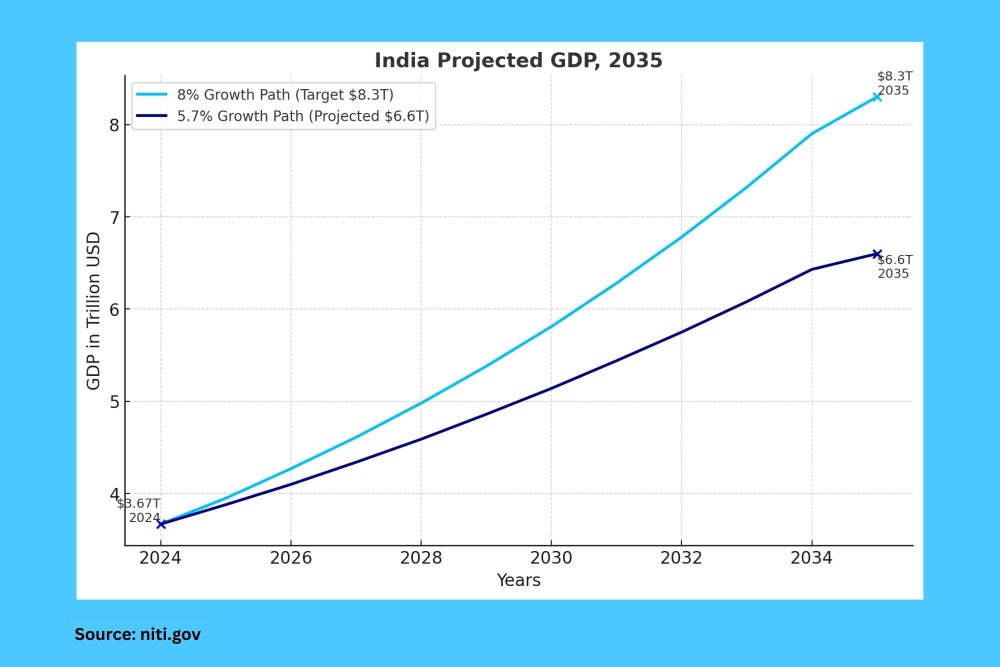
Placed against India's growth aspirations, the potential becomes even more significant. At its current growth rate of 5.7 per cent, India's GDP is projected to reach USD 6.6 trillion by 2035. However, if the nation succeeds in achieving the government's aspirational 8 per cent growth path under the Viksit Bharat vision, GDP could climb to USD 8.3 trillion, an incremental USD 1.7 trillion beyond the current trajectory.
Three levers of AI potential
India's AI potential can be understood across three main areas. The first is wider adoption of AI across industries, which could improve productivity, reduce costs, and broaden access to markets.
Several industries, including manufacturing, pharmaceuticals, and automotive, are particularly well-suited for AI adoption, and together they account for nearly a quarter of India's projected GDP by 2035.
In manufacturing, AI-enabled smart factories, shared data platforms, and engineer training could modernise production. In financial services, explainable AI for fraud detection, anti-money laundering, and credit scoring, combined with consent-based data sharing and certification programs, can strengthen trust.
Pharmaceuticals could shorten drug discovery timelines through expanded biotech parks, a unified omics database, and large-scale training in computational biology. The automotive sector could advance towards autonomous mobility through testing facilities, smart corridors with 5G and 6G, and anonymised vehicle data. Similar strategies could extend to construction, retail, and professional services, widening AI's impact further.
The second area is research and development, where generative AI could help create new markets, update value chains, and speed up commercialization, contributing another 20 to 30 per cent.
The third area is technology services, where integrating AI into existing strengths in IT and digital services could add a further 15 to 20 per cent to the growth step-up.
Reflecting on this transition, Debjani Ghosh, distinguished fellow at NITI Aayog and chief architect of the Frontier Tech Hub, said, "The last one year has been truly humbling to see brilliant minds come together to shape this work. Nations that secure critical technologies set the course for the future, and spotting them early is essential."
The road ahead
The impact of AI will depend on how well India prepares its workforce for the changes ahead.
Globally, the World Economic Forum estimates that 23 to 25 per cent of roles will shift within five years, with millions of new jobs created but many others disrupted. For India, where gig and platform workers are expected to reach 23.5 million by 2029–30, the need for reskilling and safety nets is urgent.
Reskilling strategies could include job transformation maps for key sectors, firm-level training plans, and lifelong learning accounts similar to Singapore's SkillsFuture or the UK's Lifelong Learning Entitlement. Industry-wide AI adoption toolkits and micro-credentials can help businesses manage transitions, while universal registration on platforms like e-Shram can extend benefits such as health insurance, accident cover, and retirement savings to gig workers. Alongside this, promoting financial and AI literacy will be essential to build trust and encourage adoption.
For India, the AI revolution represents far more than the adoption of a new technology. It is a chance to modernise industries, create inclusive growth, and protect its workforce, all while pursuing the government's vision of Viksit Bharat by 2047.