IndiGo: Pieter Elbers's Next Bold Moves & Conviction For Growth I'm a believer in evolution and not revolution. There will be gradual changes in IndiGo and the plan looks like climbing a mountain, you keep going!, says, Pieter Elbers, CEO, IndiGo, in an exclusive conversation with Entrepreneur India.
Opinions expressed by Entrepreneur contributors are their own.
You're reading Entrepreneur India, an international franchise of Entrepreneur Media.

When Peiter Elbers joined IndiGo as the CEO in 2022, he knew the inside scoop…a strategy was already in place. What followed next was a vision laced with risk and fueled by conviction.
IndiGo, a low-cost carrier (LCC), launched its business class service in 2024 and first long haul flight in July 2025. Was Elbers's induction the first step towards taking a leap of faith?
Soon after Elbers joined, somewhere in early 2023, Indigo rolled an advertisement – cabin crew trainers with business class / premium class experience needed. "Experience on International highly reputed carriers and business class experience is required," it quoted.
An LCC launching business service and long haul international flights is a bold step. Historically, many LCCs took the initiative and have not seen high success rates. But Pieter Elbers is confident.
Rahul Bhatia, promoter and MD of IndiGo's parent firm InterGlobe Aviation, had shared his vision with Elbers when both met for the first time. "We discussed a strategy and then the execution began," said the CEO. 'Towards new heights and across new frontiers', that's what the CEO labelled the strategy.
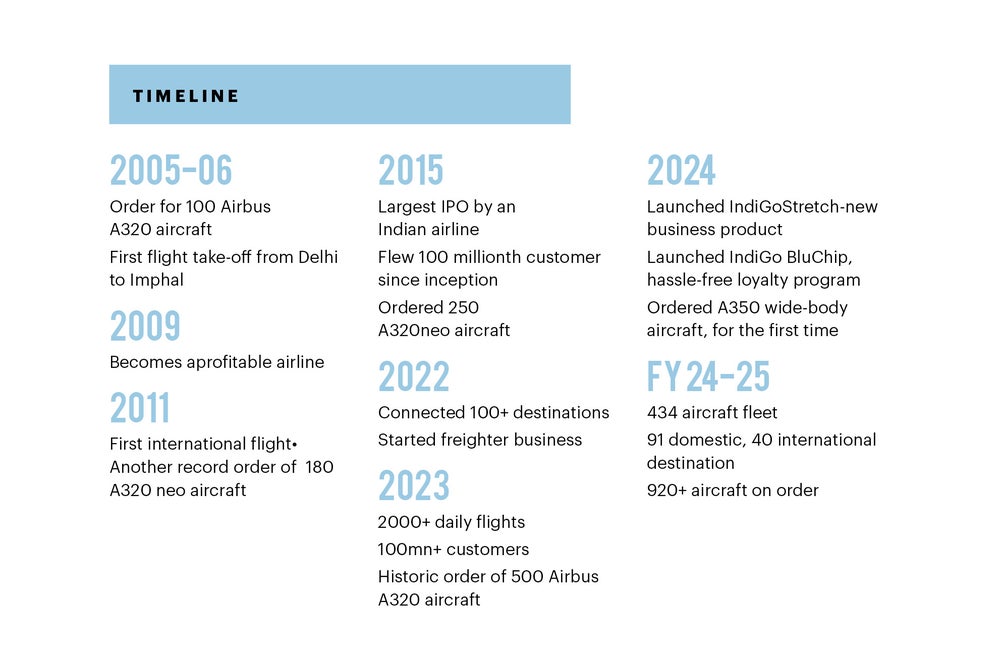
In November 2024, IndiGo launched the business class service, IndiGoStretch. Till date the service has been launched in eight domestic and nine international destinations. The airline also launched its first long haul international flight in July 2025 from Mumbai to Manchester.
"We are not a classical low cost airline. Before launching the long haul, we introduced the premium business products in domestic routes. We have a loyalty program which has four million members now. We have codeshares with other airlines. Cargo, corporate contracts and operations from all major airports, give us the differentiating factor," he said.
"IndiGo is a fit for purpose product. We operate on a low cost basis and that's perfectly fine. Our business product can compete with any other international airline. So, we left that station of a classic low cost airline some years ago. If IndiGo wants to compete with world class airlines, we need to be ready. We have arrived," explained the CEO debunking the concept that LCCs cannot survive business class products and long haul flights.
The bold moves in business are complemented by Elbers's wealth of experience in full service carrier, KLM, a royal Dutch airline. When asked if the moves were preplanned since his joining, he said, "No. When I had my initial discussions, it was clear that the growth of IndiGo should not stop at the geographical borders of India. Neither should we be limited to a single service. Three years down the line, I think we've taken a lot of steps and new initiatives have been launched."
The airline reported a strong financial performance in FY 2025, resulting in IndiGo becoming a $10 billion revenue company – only among 20 other airlines globally.
The June quarter of FY25-26 was shaped by significant external challenges that created headwinds for the entire aviation sector. "Despite these industry wide disruptions, we reported a net profit of INR 21,763 million with a net profit margin of around 11 per cent for the quarter ended June 2025. Looking forward, we remain optimistic about the growth of air travel and with our scale, network and fit for purpose fleet, we remain committed to serve the growing demand," the CEO explained.
The CEO isn't complacent and is aggressively working on an expansion plan.
Going Global
When Elbers joined, international destinations were 25 and now it's 46. "The geographical position of India allows us to fly to the East. And that's where we've added a lot to Singapore, Bangkok, Malaysia, Thailand, and Hong Kong. We've developed to the West and what was missing was a direct link to Central Asia. We are at it now."
Basically, India's central location makes it a lucrative epicenter for connection. "As much as 65 per cent of the world population lives within five to six hours flying from India," he quipped.
The company is aiming to end FY26 with almost 50 international destinations. "We have added 10 destinations this year. We should end this financial year in the range of 50, might be a couple of more. Out of these, four or five in Europe, another four in Central Asia, it all depends on airspace limitations. We might add one or two more in Cambodia and Southeast Asia. We will keep expanding our code share agreement and now we have moved to a reciprocal partnership."
Talking about the latest development in code share agreement, he said, "By the start of this winter, we should have it across the Atlantic region with Delta airlines. It's going to be executed."
The Moves
IndiGo operates in 95 domestic cities across 500 routes. "We're really giving wings to the nation and helping smaller communities to develop. Aviation is contributing to the local economy of smaller towns in terms of jobs, people, connections, business and tourism. Domestic tourism is booming and there is no airline in the country operating more cities than we do and that number obviously will continue to rise."
IndiGo has a 65 per cent share in the domestic market, "I am not focused on expanding the share, I am rather all into feeding the hubs which will in turn boost the outcome."
The real next move is the share of Indian operators in international travel. "The further you're away from India, the lower that share is. To Europe, 70 per cent or even more of all the flights are operated by European operators. Only 25 percent are Indian operators. The opportunity for us to offer Indian consumers to fly with an Indian operator on non-stop flights to Europe, is a massive chance."
When asked about long-haul flights to New York, he said, "We are creating the foundations for what is next. If we want to operate in the U.S, we need to have a U.S. partner, a loyalty program, a premium product and deep partnerships. Three years ago, we did not have these. But now, we have launched many of these initiatives and are making our foundation strong. Hence I can say, the US is not far away."
From 28 per cent current international capacity share, the airline is aiming for 40 per cent by FY 2030.
Soaring Higher
"In the global top 10 airlines, there should be a place for an Indian operator, that's what we aspire," said the CEO.
IndiGo ranked 39th in Skytrax, an international air transport rating organisation, report in 2025. With a fleet of over 400 aircraft and 920-plus aircraft on order, IndiGo is in line with India's vision of becoming a global aviation hub.
At the 81 IATA AGM hosted by IndiGo in New Delhi, the airline announced new international destinations, partnerships, MRO in Bengaluru and signed an MOU (Memorandum of Understanding ) with Airbus for another 30 A350-900 wide body aircraft, doubling the existing order from 30 to 60.
Fast forward, in October 2025, it signed a contract with Airbus confirming the conversion of 30 out of its 70 purchase rights of Airbus A350-900 aircraft into firm orders.
The airline has launched Manchester, and Amsterdam recently with Copenhagen, London and Athens to follow soon with its fleet of temporarily damp-leased Boeing 787-9 and soon to be inducted Airbus A321XLR aircraft. In addition, it is also strengthening its network across Asia. The arrival of the Airbus A350 aircraft will further extend its capabilities and open new routes to the US and other long-haul destinations.
With the ongoing supply chain disruption, the airline is set to receive its wide body aircraft beginning 2027. Intermediately, it has a temporary strategy.
"We just can't wait for 2027. That's why the XLRs are coming in by the end of this year and that will allow us to extend our range. We have signed up for an arrangement with Norse Atlantic Airways for damp leasing of several Boeing 787-9 aircraft to continue with our long-haul international flights," Elbers explained.
Offsetting Cost
Despite headwinds during the first quarter of FY2025, the airline managed to end the period with profit.
Moving towards the second quarter, the CEO emphasized that Q2, is traditionally a slower season, still stabilization is expected. "We reconfirmed in our last earnings call our capacity guidance for the full year. Despite the challenges we are aligned with our ambition to grow."
Airlines offset cost pressures through various strategies including hedging against currency fluctuations, improving operational efficiency, increasing ticket prices, and reducing expenses.
When IndiGo was created 19 years ago, it was built on three customer promises, on-time performance, a purchase and hassle-free service, and affordable fares.
Affordable fares have been a success story for the company. When asked about the cost strategy, the CEO said, "One needs to have a very strong focus on cost. India being a competitive market, and such a price-sensitive or value-conscious nation, cost is a major parameter. If we compare an Indian flight with Europe or the US, we will realize the competitiveness of the market."
IndiGo has begun the construction of its MRO (Maintenance, Repair, and Overhaul) facility at Kempegowda International Airport in, Bengaluru. The upcoming MRO is set to be fully operational by early 2028, capable of handling both narrow-body and wide-body aircraft. The airline already operates two MRO hangars each in Delhi and Bengaluru, handling line maintenance and routine checks for its fleet.
"We are developing our MRO facility in Bangalore and this will help us keep costs down. Cost focus is needed in order to have a sustainable operation in India, including our international expansion. We keep investing in amenities which will help sustain our business in a cheaper, faster, quicker and a better way," Elbers explained.
MRO operations are generally considered highly labor-intensive, especially for heavy maintenance and overhauls in the aviation industry. The level of labor intensity, however, varies depending on the specific MRO segment.
"We don't have a shortage of staff in India, they are willing to work and grow. I'm bullish on the opportunity which we can create here with MRO."
CEO Foresees
With expansion across capacity, fleet, customers, destinations, and teams, the airline is steadily pursuing its ambition of becoming a global airline.
For the year 2026, Elbers already has a plan of action: From further expanding its domestic network in India to hiring the right talent.
"We will increase our domestic network with more routes and destinations. Having the right talent on board is the focus area. Our training center trains over 2,000 people a day, frontline staff and professionals. We are also betting big on our digitization opportunity. When I joined, a lot was to be done on the digital side, we were still behind in terms of using Cloud, and other innovations. Today, we are already investing in technology and updated our tech stack," added Elbers.
IndiGo aims to be in the global top 10 airlines; is it a far-fetched dream? "We are number seven in terms of daily departures and we aspire to double in size by the end of this decade. We should make sure that India has a powerful airline or airlines, which are a great representation of what the country stands for, in terms of economic growth and potential skills. With the influx of investments, the opportunity for India is huge."
IndiGoStretch is one of the pillars of the airline's expansion plans. The premium cabin service, which is a business class product with wider seats, extra legroom, and priority services, features 12 seats in a 2-2 configuration, out of 220 seats. Almost a year to its launch, the CEO is optimistic about its growth.
When asked about expanding the product, he said, "We've only introduced it on the nation's busiest and business routes. We fly 500 domestic routes, we'll have this on around 20 routes. We could expand maybe in the future to other business cities like Pune. There are different opportunities, we haven't decided anything on that yet, but we are not expanding it in size."
With a playbook ready for 2026, Pieter Elbers is bent on turning challenges into opportunities, as he quipped, " I'm a believer in evolution and not revolution. There will be gradual changes and it's like climbing a mountain, you keep going!"