The Psychology Secrets Behind Guinness, Apple, and Pringles — And How They Can Work For Your Brand
Find out the behavioral science principles behind five billion-dollar brands, and how to apply them to market your business.

Dan Matutina
This story appears in the January 2026 issue of Entrepreneur. Subscribe »
It’s one thing to look at a genius advertising campaign and say: “I wish I could do something like that.” It’s something else to say: “I want to do something like that, and I’m confident trying because I know why it worked.”
Too often, as entrepreneurs, we rely on instinct, intuition, and the idea of “marketing magic,” but not enough on evidence. That’s what brought the two of us together — MichaelAaron, an entrepreneur who’s built nine companies based on behavioral science, and Richard, who’s written three books on the topic. We’re both marketing experts, searching for ways to make our work more effective. We realized that all around the world, researchers are running randomized controlled trials, testing interventions, and publishing papers that show how humans actually make decisions. But their findings are rarely put to commercial use here in the United States.
By identifying the tactics of some of the world’s best brands, and examining their behavioral science underpinnings, you can find strategies you might want to adopt for yourself. That way, you can get rid of the guesswork and power up your own marketing efforts with evidence.
Related: Most Businesses Overcomplicate Their Marketing Strategy. Here’s Why — and What to Do Instead.
Here, we look at five leading brands. We’ll examine what initially made them successful, and then we’ll go beneath the surface to connect their actions to behavioral science principles. And as all good entrepreneurs know, imitation won’t suffice. But consider this a shortcut — a way to leap years ahead of expensive trial and error by learning what others have already figured out and proven.
How GUINNESS earns people’s trust
(By using the pratfall effect)
In 1759, Arthur Guinness took out a 9,000-year lease on St. James’s Gate brewery in Dublin, Ireland. That’s how confident he was of future success. And his confidence was well-placed. Ten years later, he began exporting to Great Britain, and today the brand is available in 150 countries.
Up until 1929, Guinness didn’t advertise; the family let the product speak for itself. They were finally persuaded to start advertising on the condition that the ads would be as high-caliber as the stout. And they started strong: Their first campaign featured the now famous “Guinness is good for you” slogan, penned by novelist (and natural copywriter) Dorothy L. Sayers. Classic artwork came from John Gilroy. Since then, Guinness advertising has earned cult status. And in 1997, when Guinness put its account up for pitch, the brief sent out to agencies included one interesting stipulation: under no circumstances should the campaign talk about the stout’s slow pour. The aim was to win over lager drinkers and the brand was concerned the wait might put them off.
One of the agencies asked to pitch was Abbott Mead Vickers (AMV). Thankfully, AMV creative Walter Campbell wasn’t a strict rule-follower. A few thoughts came to him, including reviving the original concept of “goodness” from the first-ever Guinness ads. He went back to the brief and carefully ignored its stipulations.
Why? Because he’d noticed something about his friends’ drinking behavior. They actually liked how long it took for a Guinness to pour. It served to fuel the anticipatory joy of the night ahead. Combining this sense of anticipation with the idea that Guinness is good, he came up with this tagline: “Good things come to those who wait.”
AMV won the business. Its first ad emphasized the exact time it takes to pour the perfect pint — 119.5 seconds — and how that signals quality and credibility. AMV followed that with the now-famous “Surfer” ad in 1999, which depicted a surfer gazing intently and patiently out to sea, trying to spot the perfect wave before plunging into the water as a voiceover says, “Here’s to waiting.” The results were impressive: The campaign, according to Campbell, was credited with a 12% increase in Guinness sales. The idea was reprised in a 2020 TV commercial featuring quarterback legend Joe Montana and the famous Super Bowl touchdown that had fans waiting on the edges of their seats.
Consider the psychology here. A two-minute pour sounds like a turnoff — especially if you’re used to fast-flowing lager. It seems counterintuitive to highlight that in your commercials. But by choosing to acknowledge it, Guinness taps into a powerful bias. It’s called the pratfall effect.
Related: Your Current Digital Marketing Strategy Won’t Hold Up in 2026. Here’s the New Playbook.

The pratfall effect comes from a 1966 study by psychologist Elliot Aronson. He found that people like someone more when they make a small, humanizing blunder — like in his study when someone aces a quiz, but then spills some coffee on themselves. But very importantly, the effect only works if the person is already seen as capable. If a person is viewed as less competent (like, say, doing poorly on a quiz and then spilling coffee), then mistakes make them seem even more unlikable.
Image Credit: Dan Matutina
Guinness isn’t literally admitting a “mistake” here — the long pour isn’t an actual blunder. But the brand is banking on something similar: By acknowledging a potential consumer objection, and then reframing it as a sign of craftsmanship, it’s displaying the confidence of competence. Only a brand with a deep belief in its product can spotlight a perceived drawback and turn it into a strength.
Many brands have succeeded with this strategy. Think about the classic Volkswagen ads with lines such as, “Ugly is only skin-deep,” “Lemon,” or “America’s slowest fastback.”
Or Avis: “When you’re only No. 2, you try harder.” Or Listerine: “The taste people hate. Twice a day.” Or Southwest Airlines: “We’re Not Fancy.”
Again and again, the greatest brands boost their appeal by admitting a weakness.
But before you rush to apply this idea, remember the nuance of the pratfall effect: Mistakes or flaws are only charming if they’re coming from competent people. So before you share your brand’s weakness, you must establish yourself as credible and high-quality. Once you have your customers’ confidence, a small blunder — or fessing up to a “flaw” — can make you a lot more likable.
How KRAFT seems so delicious
(By using expectation assimilation)
Mmm, mac and cheese. It’s the ultimate quick and easy comfort food — and we’re under no illusion that it’s healthy. But its nutritional credentials may be better than you think. That’s because, when Kraft improved its recipe, it was surprisingly crafty about how it rolled that information out. Let’s take a look at why.
Kraft Mac & Cheese began almost 100 years ago with a salesman’s clever idea: He attached a pack of Kraft cheese to boxes of pasta, then sold them as a pair. Kraft itself developed the idea further, and in 1937, just before the outbreak of World War II, it sold its first boxed macaroni and cheese. The food was an immediate hit. In the first year of launch alone, nine million boxes were sold, and its popularity hasn’t dipped since. Kraft now reportedly sells a million boxes per day.
But about a decade ago, as consumers became increasingly focused on natural foods, Kraft decided it was time to improve the health credentials of its recipe, and cut out artificial ingredients like preservatives, flavorings, and colorings. Many brands would likely make these sorts of changes with huge fanfare. Kraft did not.
Related: The Most Dangerous Digital Marketing Mistakes New Entrepreneurs Make
Instead, in 2016, it made the change with no announcement at all; its ingredient list simply changed. Gone, for example, were the artificial colors used previously — now replaced by spices such as paprika, turmeric, and annatto. And nobody seemed to notice or care. Sales remained strong.
So, why didn’t Kraft trumpet its recipe improvements?
Kraft may have understood something behavioral scientists have shown again and again: People don’t just taste food—they taste their expectations.
When we see a “healthier” version of something, we expect it to taste worse. That expectation can then change our sensory experience, so that it literally does taste worse. Psychologists often call this either expectation effects (which is kind of like the placebo effect: you experience what you believe to be true) or assimilation effects (which is to say, our brains bend new information toward what we already believe).
For simplicity, we’ll call this expectation assimilation — the idea that expectations color our perception.
This can be a problem for healthier brands. Even though people say they want healthier food, they expect that food to taste bad. Then this negative expectation can become self-fulfilling.
Perhaps that’s why many people don’t buy healthy items in the first place. When a brand markets itself as healthy, it risks turning off consumers who are more interested in taste and indulgence.
Evidence of this can be found in a 2017 Stanford University study: Researchers set up at a large university cafeteria and, over the course of seven weeks, used varying descriptions on a healthy vegetable dish. These are the four different types of descriptions they used:
- Basic description (e.g., “plant-based beans and shallots”)
- Healthy restrictive (e.g., “light ‘n’ low-carb plant-based beans and shallots”)
- Healthy positive (e.g., “healthy, energy-boostingplant-based beans and shallots”)
- Indulgent (e.g., “sweet sizzlin’ plant-based beans and crispy shallots”)
The results: Compared to the basic option, “healthy positive” labels reduced sales by 7%, and “healthy restrictive” labels reduced sales by 11%. The only way to boost sales was to describe dishes in an indulgent way — which increased sales by 25% versus the basic option.
This finding has widespread applications, which goes beyond just “healthy” food. It applies to any products that are aiming to be more responsible. For example, when eco-friendly light bulbs were first hitting the market a few decades ago, Philips released a CFL light bulb and marketed it as being good for the environment. It sold poorly. Then they rebranded it as “Marathon,” and emphasized how long it lasted (and therefore how infrequently it needed to be changed), and it sold much better.
Related: Stop Worrying About AI Taking Your Marketing Job — and Start Doing This Instead
It’s the same takeaway as the Stanford study: People respond more to desirable outcomes—whether it’s taste, convenience, or something else — and less so to things that feel dutiful, like eating healthy or being eco-friendly.
This could have easily been on Kraft’s mind as they rolled out their improved ingredient list. They waited until everyone ate and enjoyed the new recipe—and only then shared that it was healthier. That way, they avoided misconceptions while still doing the right thing.
How DYSON seems so innovative
(By using the Illusion of Effort)
When Dyson launched its DC01 vacuum cleaner in 1994, the company hammered home this message: This invention took a lot of work!
An early advertisement stressed it this way: “After testing over 5,000 prototypes, [James Dyson] created the first vacuum cleaner that doesn’t lose suction.”
And in interviews for decades, James Dyson has repeatedly stressed how much work goes into his innovations. “We develop technology iteratively, making the smallest changes, building prototype after prototype until we have got it as close to perfect as we can muster,” he once told the BBC, for example. “Testing and prototyping is at the heart of the most successful technologies.”
Why do they keep focusing on this? First, because it’s true: Dyson created an entirely new approach to vacuum cleaners, and the iteration process took 15 years.
But there’s likely another reason: It’s because Dyson understands what psychologists call the illusion of effort. People tend to perceive a product or service as more valuable, higher quality, or more trustworthy when they believe significant time, work, or dedication was put into its creation. Or, in other words: “If this took a long time to make, it’s probably good.”
Related: How to Tell If Your Marketing Is Driving Real Business Results
Here’s a study that captures this, done in 2004 at the University of Illinois Urbana-Champaign. Study participants were split into two groups, and both asked to read a certain poem. One group was told: The poet spent four hours writing this poem. The second group was told it took 18 hours. Afterward, the groups were asked to rate the poem — and the “18 hours” group rated the poem 10% better than the other group did. They also believed the poem would sell to a poetry magazine for 90% more money.
It’s a stark outcome: The exact same piece of work was considered better and more valuable, solely because people believed more effort went into it. The lesson for any brand, then, is to be transparent about the lengths you’ve gone to create your product. It’s not enough to expend lots of effort; you must let your customer know.
How APPLE beat the competition
(By using the concreteness effect)
Music was revolutionized in the early 2000s. That’s when the first MP3 players hit the market, enabling people to carry digital files with them anywhere.
So, how was this revolution marketed?
Here’s how Philips promoted its Rush digital audio player, which launched in 2000. Its print ad headlines said: “MP3 in full motion.” Then it offered a bulleted list of features, such as “Built-in memory capacity: 128 MB” and “Plays MP3 and WMA digital audio.”
Then Apple released the iPod in 2001. One of its early ads simply said: “1,000 songs. In your pocket.” Its TV ads were mostly about vibe — those bright colors and dancing black silhouettes. And as we all now know, the iPod dominated the marketplace and defined MP3 players for a generation.
So, why was Apple’s marketing approach so effective? Psychologists call it the concreteness effect.
The concreteness effect says this: Concrete information (like things you can picture) is easier to understand, encode, and recall than abstract information. While Philips focused on abstract ideas, like 128 MB of storage (which means nothing to the average person!), Apple leaned into “1,000 songs” (which absolutely does). Apple’s ad gave us something we could picture in our minds, which is scientifically proven to help us remember the concept.
One of the original studies into concreteness was carried out by Ian Begg at the University of Western Ontario in 1972.
He recruited 25 students and read them a list of 20 two-word phrases, such as: square door, impossible amount, rusty engine, better excuse, flaming forest, apparent fact, muscular gentleman, common fate, white horse, and subtle fault.
Related: Why Marketing Savvy is the Important Attribute of Successful Entrepreneurs
Then he asked the group to remember as many terms as they could. Participants recalled an average of 23% of them. But Begg made a striking observation: People remembered just 9% of the abstract terms (like “impossible amount”) and 36% of the concrete terms (like “white horse”). That’s a fourfold difference! Why? Begg believed it was because those concrete terms could be visualized — and when you can picture something in your head, such as a white horse, you find it easier to hang on to that thought.
The best brands are visual — in their marketing, product descriptions, and even in their taglines. Consider Red Bull. They could have used “Red Bull gives you energy,” but that’s impossible to visualize. So they went with “Red Bull gives you wings,” which is much more memorable. Skittles did it with “Taste the rainbow,” M&M’s with “Melt in your mouth, not in your hand,” and Maxwell House did it with “Good to the last drop.”
So as you draft your next marketing copy, trying to cut through the clutter, it’s worth asking yourself: Are you giving people something they can easily remember?
How PRINGLES became so memorable
(By using the Keats heuristic)
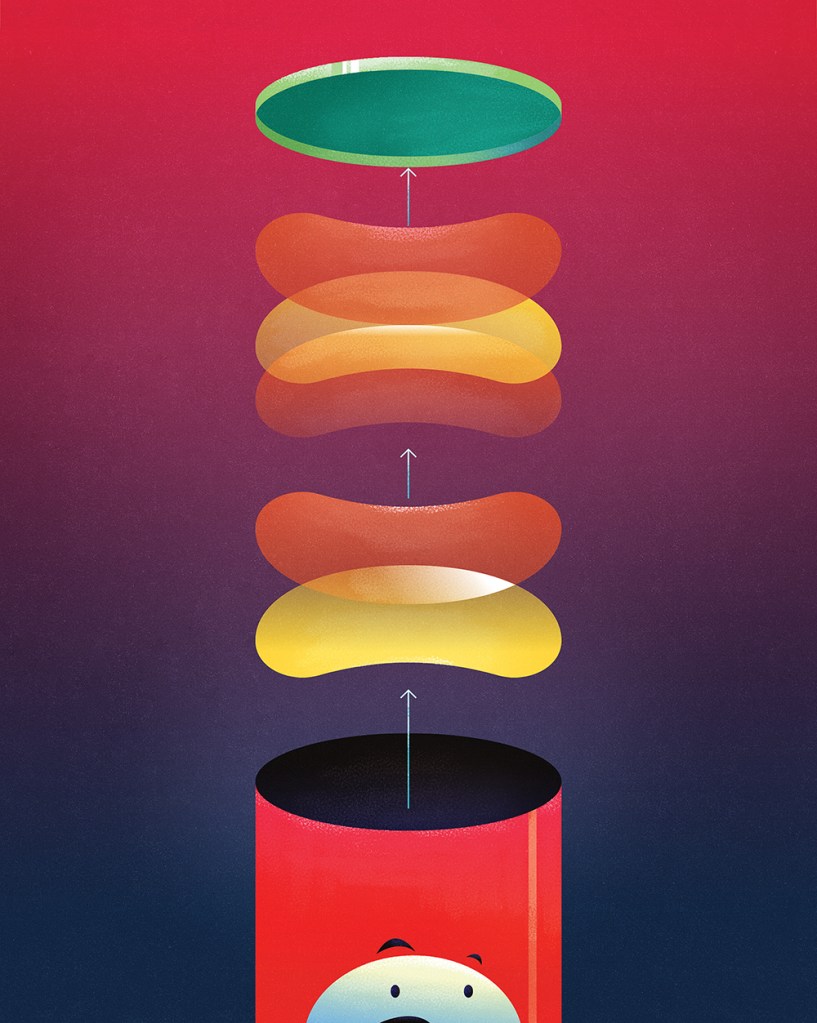
Everyone knows the Pringles tagline: Once you pop, you can’t stop.
But it’s more than just a fun rhyme. It also takes advantage of a funny shortcut known as the Keats heuristic. The Keats heuristic is the scientific finding that rhymes make things sound more true. Therefore, brands like Pringles can make use of rhyme to sway consumers toward the credibility of their claims. We don’t question how addictively delicious Pringles chips are, because “once you pop, you can’t stop” — it just sounds true.
To be clear, this idea isn’t universally accepted — but it has been identified by some very noteworthy experiments.
The most famous one is from 1999, by psychologists Matthew McGlone and Jessica Tofighbakhsh from Lafayette College, Pennsylvania. They gave participants a list of lesser-known proverbs. Some of those proverbs rhymed; some did not. (For example: Some participants heard “Woes unite foes” and others heard “Woes unite enemies”.) Afterward, participants were asked to rate the truthfulness of the proverbs they heard. They trusted the rhyming proverbs 17% more.
Image Credit: Dan Matutina
Why would this happen? Here’s the hypothesis: Rhymes improve reading flow, making a sentence easier for our brains to process. And we equate ease of processing with truth.
Related: I Run A Global Advertising Agency. Here’s How We Create Great Ideas — By Rewarding Lots of Bad Ideas
(McGlone and Tofighbakhsh were the ones to coin this the Keats heuristic. It’s a reference to a line from the poet John Keats: “Beauty is truth, truth beauty.” The idea is that a beautiful rhyme can create the feeling of truth.)
Another research team, based at the University of Oslo and the Norwegian University of Science and Technology, attempted a similar experiment in 2013 — but specifically looked at brand marketing. They generated slogans for brands that either rhymed or didn’t, then asked participants to read and respond to the slogans. The rhyming slogans were easier to remember (by 25%), and were also more likable (24% higher), trustworthy (22% higher), and persuasive (21% higher).
So it’s no wonder that brands like rhyming slogans! Bounty calls itself “the quicker picker-upper.” Folgers says, “The best part of waking up is Folgers in your cup.” And Pringles has spent decades creating rhymes — at least as far back as a ridiculous 1980s ad starring Brad Pitt, which called Pringles “the fever reliever.” (The “fever” here was a fever for snacks.)
What’s the lesson in all this? It’s simple: There is a lot more to marketing than just pitching why your brand’s great. It’s about understanding the people you’re marketing to. The more you understand these common human biases, the more you can tailor your message to be as memorable, trustworthy, and effective as possible. Or, to be inspired by the Keats heuristic: If you learn the brain, you’ll win the game.
Adapted Excerpt from Hacking the Human Mind: The Behavioral Science Secrets Behind 17 of the World’s Best Brands by Richard Shotton and MichaelAaron Flicker, published by Harriman House, an imprint of Pan Macmillan, on September 30, 2025. Copyright © 2025 by Richard Shotton and MichaelAaron Flicker.
Sign up for the Entrepreneur Daily newsletter to get the news and resources you need to know today to help you run your business better. Get it in your inbox.
It’s one thing to look at a genius advertising campaign and say: “I wish I could do something like that.” It’s something else to say: “I want to do something like that, and I’m confident trying because I know why it worked.”
Too often, as entrepreneurs, we rely on instinct, intuition, and the idea of “marketing magic,” but not enough on evidence. That’s what brought the two of us together — MichaelAaron, an entrepreneur who’s built nine companies based on behavioral science, and Richard, who’s written three books on the topic. We’re both marketing experts, searching for ways to make our work more effective. We realized that all around the world, researchers are running randomized controlled trials, testing interventions, and publishing papers that show how humans actually make decisions. But their findings are rarely put to commercial use here in the United States.
By identifying the tactics of some of the world’s best brands, and examining their behavioral science underpinnings, you can find strategies you might want to adopt for yourself. That way, you can get rid of the guesswork and power up your own marketing efforts with evidence.


