
The Future of Customer Conversations Is Here, And It Sounds Human
Edited by Entrepreneur UK
You're reading Entrepreneur United Kingdom, an international franchise of Entrepreneur Media.

For decades, customer communications have been defined by long queues, rigid scripts, and the dreaded sound of hold music. For many customers, it felt less like service and more like endurance training.
That frustration has led companies to explore alternatives. The call center model with its spiraling costs and long processes, is being steadily rewritten.
A new generation of voice AI and conversational AI is showing how technology can handle the basics of communication more efficiently. Calls can be answered in seconds, straightforward requests resolved quickly, and staff freed to focus on situations that require human judgment.
The goal is not to replace people, but to reduce the wasted time that frustrates both customers and employees.
And the outcomes are real. In logistics, companies such as Einride have reported annual savings by introducing 24/7 automated ticketing solutions using Callers. Lead revival cadences using AI have shown strong returns by re-engaging dormant prospects. Even large-scale events, like those run by Robbins International, have used voice AI to expand outreach.
Outbound has often been the harder side of the equation. Sales teams spend hours chasing leads that rarely answer, while prospects lose interest if responses are delayed. AI outbound calling helps close this gap by ensuring faster and smarter follow-ups.
Instead of cold follow-ups using emails that frustrate both sides, businesses can begin to deliver timely, relevant conversations that feel personal.
This shift is no longer experimental. Automated customer communications - inbound and outbound - are moving toward the mainstream. Analysts track rising adoption across multiple sectors, and surveys consistently show that customers remain loyal when they feel heard. Companies are adopting these technologies not because they are trendy, but because scaled connection is becoming essential.
Something Nimrod Ron, the CEO of Callers, recently pointed out stands out: the hardest part of adopting new technology isn't the tech itself, it's the timing.
Companies that wait for "perfect maturity" usually miss the curve.
With voice AI, the early adopters can build a structural advantage in speed, customer experience, and costs. As Nimrod puts it, the winners of the next decade will be the ones who start experimenting now, not later.
Customer communications has walked a delicate tightrope between efficiency and empathy.
Earlier tools often tilted too far toward efficiency and left people feeling cold. This new generation of conversational AI shows it's possible to balance the two: conversations that sound recognisably human, backed by systems that are designed to never miss a follow-up.
When explored how Callers frames its approach and the picture sharper.
Scale is no longer a question. Callers is designed to hold conversations with your entire database simultaneously, in any language, at any time of day. Intelligence comes from direct CRM integration, ensuring responses are grounded in live business data rather than generic scripts.
Another important advantage is insights: sentiment, objections can now be captured in real time, giving companies a real view of customer needs that surveys or reports often miss.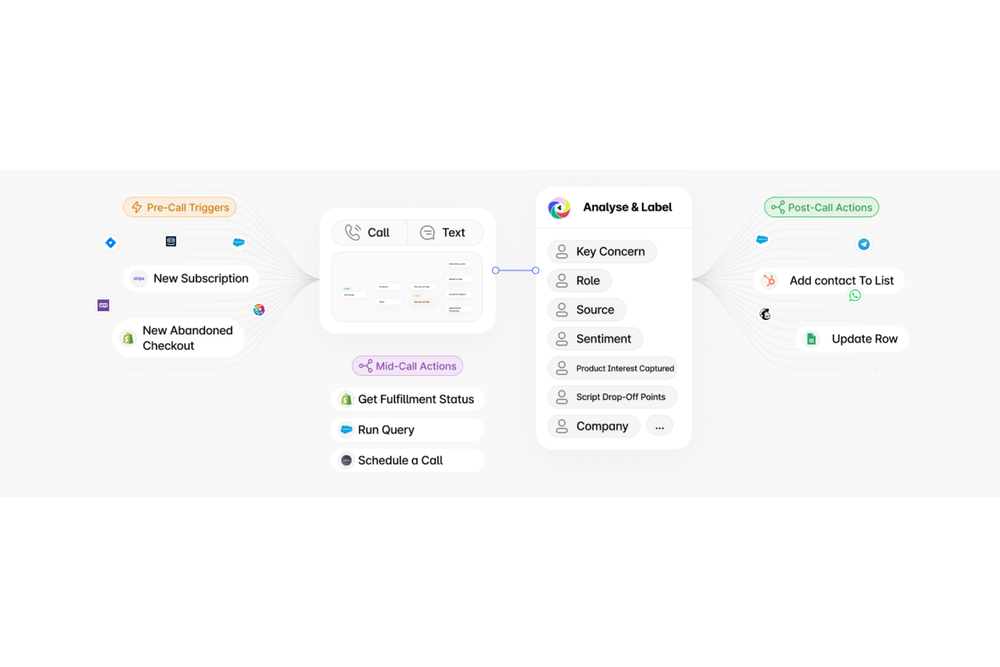 (Source: Callers website - visual overview of the voice ai technology workflow)
For many companies, the barrier to adopting AI isn't whether the technology can work.
it's whether it will be run responsibly. Dedicated success managers provide a layer of trust and accountability, ensuring the platform evolves alongside the business and delivers consistent outcomes over time.
Customer communications have always balanced efficiency and empathy. Earlier tools leaned too far toward efficiency and left people feeling cold. This new wave of conversational AI shows it's possible to achieve both.
Customers get the speed they expect and businesses get the scale they need.
The future of conversations won't be defined by hold music or missed follow-ups, but by immediate, meaningful connections.
As voice AI matures, the companies that adopt it early will set the pace for what customers and prospects come to expect everywhere else.
AI conversations aren't a future bet - they're happening now.
The only question is how soon you're ready to compete at this new pace.


