Inside FII9: Dunia Innovations The FII9 Innovators Pitch 2025, hosted by the Future Investment Initiative (FII) Institute, spotlighted five startups that presented breakthrough AI-powered solutions transforming healthcare, sustainable materials, and next-generation computing. In this series, we explore how each of these innovators is shaping the future with technologies designed to deliver real-world impact.
Opinions expressed by Entrepreneur contributors are their own.
You're reading Entrepreneur Middle East, an international franchise of Entrepreneur Media.

Dunia Innovations
Applying AI-driven materials discovery to advance clean energy and industrial chemistry.
With the climate change crisis becoming a more formidable threat with every passing day, the quest to discover carbon-negative and resource-efficient alternatives –particularly to replace traditionally harmful materials such as cement, steel, and composites– has become even more immediate. But while those in the fields of climate science, advanced manufacturing and renewable energy have consistently carried out extensive research and development (R&D) in this regard, there is one hidden bottleneck that has often stalled favorable results, explains Ahmed Ismail, co-founder and Chief Operating Officer at Berlin-based climatetech startup Dunia Innovations. "It still takes 20-40 years and hundreds of millions of dollars to discover and scale new functional materials such as next generation catalysts, batteries, solar cells and others," he explains. "At Dunia Innovations, we turn that into months and at a fraction of the cost using our Intelligent Research and Innovation System (IRIS), the world's first fully integrated artificial intelligence AI- and robotics-driven materials acceleration platform."
Indeed, by combining scientific principles with real-world data, the startup accelerates the discovery of materials that unlock scale in energy, manufacturing, and beyond. This has been largely achieved through bringing together a team of experts across the the fields of electrochemistry, materials science, physics, robotics engineering, business, and AI. "We have been working in the energy industry for more than 20 years and we have seen the same story over and over again: the science for clean fuels, hydrogen, fusion energy, and better batteries has already been developed several decades ago. What's missing are the functional materials that make it commercially real," says Ismail. "By functional materials, we mean, for example, more efficient catalysts that make green hydrogen and cleaner fuels with no energy penalty, better coatings that can withstand extreme temperatures and neutrino penetrations inside a fusion reactor, etc. AI alone couldn't predict and design such materials, because there wasn't enough high-quality industrial data to train the AI agents. So we asked ourselves: what if we built a system that generates its own industrially relevant data, learns from it, and keeps innovating? That's how IRIS, our materials acceleration platform, was born."
The implications of reinventing the physical materials of the world are wide-ranging— for starters, by accelerating the AI-driven discovery of such material, sustainable construction can become both profitable and scalable. But Ismail reveals that convincing industry leaders that such a future is attainable was a challenge in and of itself. "Initially, we had a technical challenge in orchestrating the response mechanism between the AI and the robots so that they can feed each other their outputs autonomously, but the hardest part was convincing the industry that AI can't just "guess" the right catalyst or coating, it has to be tied to real, device-level testing," he shares. "We overcame that by building the full stack ourselves: AI models, autonomous robotic labs, and industrial validation. Once we showed partners that we could design 80,000 candidates and deliver working materials in two months, the conversation changed. In only four months, we signed several commercial partnerships with global partners worth more than US$58 million and we are already scaling our capabilities to be able to work with more industrial partners."
A major stepping stone towards realizing this goal came when Dunia Innovations became one of the winners of the FII9 Innovators Pitch 2025– an experience Ismail describes as "electric and unprecedented." "You're standing in front of leaders who can actually deploy solutions at global scale," he continues. "Our message was simple: if we want flying cars, fusion energy, green hydrogen, we must reinvent how humanity discovers materials. Dunia is building that engine. AI plus automation can compress decades of materials innovation into months. So this win is a huge validation that the world is ready for materials innovation to move as fast as software. Our team has been building deep tech that's not always visible from the outside, but can unlock trillion dollar value for several industries. This recognition says: 'Yes, this is the right problem, and this is the right time.'"
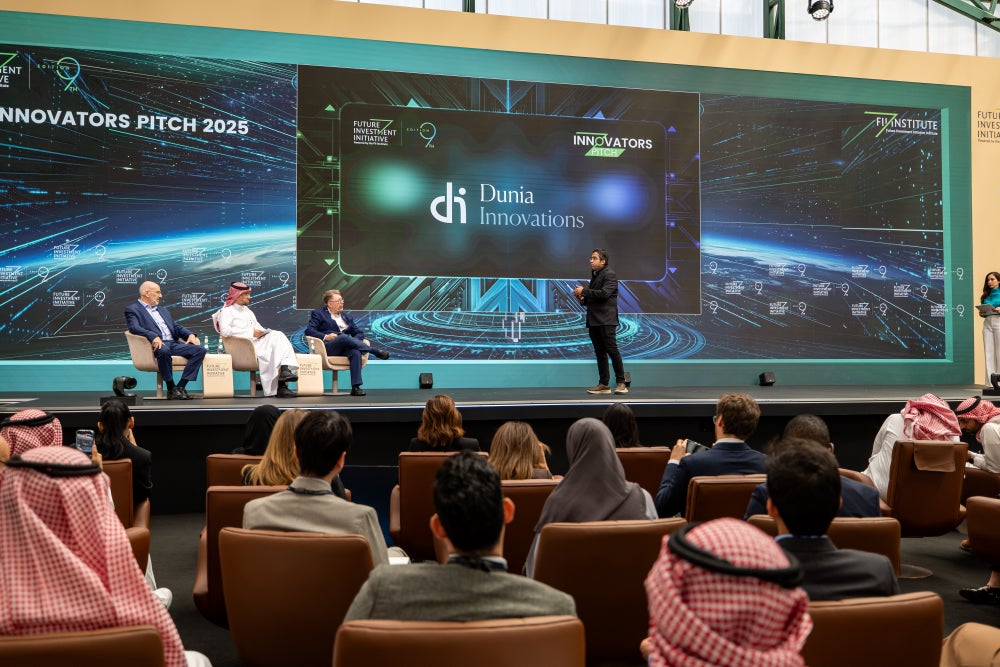 Source: FII9
Ismail also notes that the milestone opens up the path for global expansion. "This win opens doors with exactly the people we want to work with: energy leaders, multiple industry verticals, high profile investors, and ecosystem partners in the Middle East and across the world," he explains. "We're now raising funding to build our first GigaLab, which will be an enormous autonomous facility that can design, make, and test up to 1,000 materials a day. Visibility from FII9 helps boost and speed up those conversations."
As such, Ismail and the Dunia Innovations team have clear-cut targets moving into 2026. "Our biggest goal is to operate the world's most productive materials innovation engine that is able to generate new, industrially validated materials every month, and powering projects across energy, chemicals, and electronics sectors, amongst others," Ismail declares. "More concretely: We will have our first GigaLab live, generate over one million materials data points, and multiple Fortune 500 companies using our platform. Longer-term, our ultimate goal is to enable the discovery of a new type of chemistry that does not exist today– one that can change our lives for the better and enable the world to achieve better energy efficiency and complete circularity."
'TREP TALK: Ahmed Ismail, co-founder and COO of Dunia Innovations shares tips for entrepreneurs
"Build your venture to solve the hard problems. AI for consumer apps is becoming crowded and highly competitive but AI for the physical world and deeptech is wide open for innovation and disruption. Don't wait for "perfect data"; build the system that creates it. And surround yourself with partners who think in decades, not quarters. That's how you get to change a whole industry."