How Edlund Accessibility is Transforming Hospitality, Medical Tourism, and Accessible Spaces in the Middle East
You're reading Entrepreneur Middle East, an international franchise of Entrepreneur Media.

In the rapidly evolving urban landscape of the Middle East, Edlund Accessibility is emerging as a powerful advocate and partner for change. Founded by Jens Lund, the consultancy challenges conventional approaches to accessibility and pushes for design that is inclusive by default, not as an afterthought. Lund says, "Accessibility is not just compliance; it is about ensuring everyone, regardless of ability, can engage with spaces, technology, and services from the very start."
Lund's journey into this field is rooted in both a legal and advocacy background. He holds degrees in law and history and has served as an advisor on human rights and disability issues. Before launching Edlund Accessibility, he worked in one of the most well-known international health organizations and has long been a proponent of recognizing both physical and cognitive disabilities. He argues that too often, built environments, retail and hospitality spaces, as well as apps and websites, are designed without considering those whose disabilities are not obvious, such as neurodivergent people or those with cognitive impairments.
Edlund Accessibility, under Lund's leadership, offers full-service consulting to businesses and public entities and specializes in universal design. The offering spans audits, advisory support, design integrations, including plug-and-play changing places, as well as technology solutions. Clients receive bespoke recommendations not just for ticking legal boxes, but for creating spaces that are beautiful, functional, durable, and inclusive. Lund emphasises, "It's not enough to retrofit an entrance ramp or widen a door. We must rethink how every element, from architecture, lighting to voice-activation, serves people's wide range of needs."
Among the innovations Lund promotes are inclusive changing places. These spaces go beyond standard accessible restrooms, with specialized facilities equipped with a height-adjustable adult changing bench, a ceiling hoist system, as well as an elevating toilet. Furthermore, accessible hotel rooms with automated doors, voice-activated beds, and curtains. But not just catering for physical disabilities, Lund urges intuitive digital interfaces and specially designed cognitive-friendly spaces, featuring sensory-friendly lighting, for example, for those with autism.
He contends these are more than niche fixtures: "These features should be part of planning from the outset of hotels, public buildings, and hospitality projects," he says. "When you design for everyone, you lift the experience for all. Do it from the start, it's much cheaper and aesthetically pleasing."
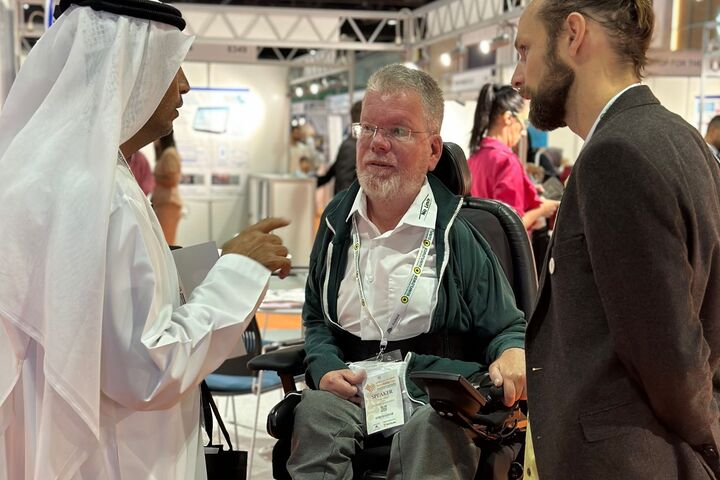
After more than 17 years in construction-based accessibility and universal design, Edlund Accessibility is making its mark in the UAE. The practice combines architectural technology, project management, and universal design principles to integrate accessibility in both physical and digital realms. From concept to project delivery, the consultancy guides clients to adopt standards such as ADA and WCAG, conducts barrier analyses, and ensures ongoing maintenance and compliance.
edlund-accessibility
The business strategy is also tied to recognizing markets: Lund sees hospitality, medical tourism, and wellness sectors as especially ripe for accessibility innovation. The accessible travel market is large and growing.
He reminds the industry that travellers with disabilities or cognitive needs expect more than just basic access; they want dignity, safety, comfort, and delight. "Hospitality that doesn't consider physical needs as well as cognitive needs, for instance, for autistic visitors or families, is missing out on entirely underserved markets," he says.
Lund started in the UAE a couple of years ago, and has been there on and off since, driven by its fast-paced infrastructure development and a growing political will toward inclusion. He believes the region offers both opportunity and urgency. "I came because, here, things can happen. Visions can be realised. There is demand. There is potential," he explains. At various sites, he notes physical changes are visible, but his vision goes further than mere spatial retrofits. Advancements need to extend to cognitive design, aesthetics, and seamless technology that "feels natural."
For Edlund Accessibility's clients, the benefit is two-fold: creating inclusive environments aligns with broader CSR and regulatory trends, and opens doors (literally and figuratively) to new customer bases. Lund's motto captures it simply: "No limits, no barriers, just accessibility." For companies in hospitality, public infrastructure, healthcare, or tourism, partnering with Edlund means being part of a paradigm shift, where accessibility is synonymous with excellence.