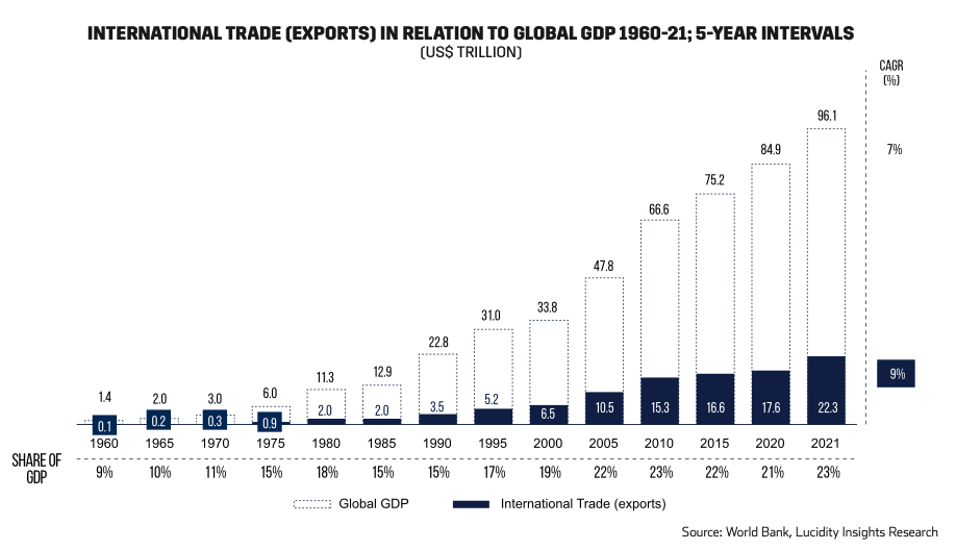
Understanding Free Trade Indicators (And Their Impact On International Trade) The growth of international trade has been impressive, and exports now comprise close to a quarter of the global gross domestic product
Opinions expressed by Entrepreneur contributors are their own.
You're reading Entrepreneur Middle East, an international franchise of Entrepreneur Media.

In 2022, DP World Group partnered with Entrepreneur Middle East and Lucidity Insights to publish Innovations in International Trade, a special report analyzing innovations in international trade.
The report covers multiple features of international trade, from its evolution, to the role it plays in uplifting societies and economies, and its future developments. It also covers the role technology has played in international trade, and what is expected going forward, given the impact of the fourth industrial revolution.
Last but not least, sustainability is a global topic piquing interest across different industries, with international trade being a significant contributor to greenhouse gas (GHG) emissions. Accordingly, this report also briefly explores initiatives that the industry is taking to address the sustainability challenge.

The growth of international trade has been impressive, and exports now comprise close to a quarter of the global gross domestic product (GDP). However, this growth has not been shared equally as some top trading countries (such as China, the US, and countries in Europe) and industries have benefited from it more than others. In fact, China has some of the busiest ports in the world, and it is also the world's largest exporter. However, the COVID-19 crisis has also made countries reassess their position on trade- there is a growing nationalization and localization sentiment to protect national interests, and ensure vital and critical products are brought back onshore to be manufactured within a country's own borders.
Nationalization mitigates potential problems, such as another pandemic-caused supply chain issues, and it has also resulted in nations adopting measures relating to taxation and trade, as well as regulation of vital industries and supply chains. Those measures can be tariffs (customs duties is the most common type), government subsidies, quotas on imports, embargos on trade with particular countries, and licenses to import goods into the country. Besides tariffs, there are also trade barriers to restrict the import or export of goods, which are considered protectionist measures.
Considering the 2019 Free Trade Rankings and Economic Freedom Summary Index, Hong Kong ranks the highest followed by Singapore, Georgia, Netherlands, and Panama. Among the major economies, mean tariff rates in India are the highest, while it's the lowest in the USA. In terms of non-tariff trade barriers, China and India rank lower on the index in comparison to the other major economies, while in the Freedom to Trade Internationally Index, European countries score better than Asian or North American counterparts.

One example of change in tariff schedules started with the Trump administration in the US in 2018, which imposed several rounds of tariffs, amounting to a total tax increase of approximately US$80 billion during his administration. The United States of America thus imposed a 25% tariff on nearly $250 billion in imports from China, and a 7.5% tariff on $112 billion worth of imports from China. In retaliation, China imposed higher tariffs on about $110 billion worth of American imports.
Check out our full report on Innovations in International Trade by clicking here.