Ecosystem in Motion: HPE Expands 'Saudi-Made' Portfolio with New ProLiant Servers With the launch of two new lines of HPE ProLiant servers, the tech giant has expanded its pioneering 'Saudi-Made' portfolio. Beyond just servers, however, here's how the initiative is setting the stage for a whole new high-tech industry in Saudi Arabia.
Opinions expressed by Entrepreneur contributors are their own.
You're reading Entrepreneur Middle East, an international franchise of Entrepreneur Media.

In 2023, during Saudi Arabia's premier annual tech conference LEAP, Hewlett Packard Enterprise (HPE) and Saudi-based alfanar company entered into a partnership with a sole vision: to bring enterprise tech manufacturing to the Kingdom and boost its ecosystem. The first step in bringing that goal to life came exactly a year later, at LEAP 2024, when both entities announced that a new facility in Riyadh was all set to begin the manufacturing of HPE's "Saudi-Made" ProLiant Gen11 portfolio. To kick this off, the HPE ProLiant DL360 and DL380 Gen11 servers were the first to be launched.
Now, while one might expect a certain level of resistance to or qualms about locally made tech products in the region, what Samer Salah, GTM Strategic Programs Director for the Middle East at HPE, reveals is quite the opposite. "When we first planned this project, we expected most of our customers to be government or semi- government organizations, since our product is on their mandatory procurement list–but to our surprise, the very first big order actually came from a private enterprise company," Salah says. "I mean, the passion that we see in top executive C-Level decision makers to support the local manufacturing and Saudi talents is amazing. So, what we noticed was that it was not a negative perception turned into a positive– from day one it has been a positive reaction that has only grown with the launch of these servers."
The project which primarily supports the goals of the Saudi Vision 2030 initiative, has received backing and participation from the Saudi Ministry of Communications and Information Technology, the Ministry of Investment, Saudi Exports Development Authority, the Communications, Space & Technology Commission and the Local Content and Government Procurement Authority (LCGPA).
But so positive was the general reception (and demand) for the first two models –which have also received the National Product Certificate– that in August this year, HPE announced the expansion of its 'Saudi Made' server portfolio with two new HPE ProLiant servers, namely DL365 and DL385 FGen11, featuring leading global chip maker Advanced Micro Devices' (AMD) 4th and 5th Gen EPYC™ processors.
"We are very agile and flexible in responding to customer and market demands," Salah says. "For example, the previous two models and the two new models each serve different use cases — whether for efficiency or other requirements. These are available in our global SKUs, and we also provide them here in Saudi Arabia to meet local customer needs. It is important here for me to set the context of the "Saudi-Made" approach: we are building a sustainable business. And to achieve sustainability, you must be agile and respond to customer needs with flexible offerings that truly serve them."
Underscoring HPE's underlying aim is to support the development of the Kingdom's $130Bn digital economy1 and meet ICT market demand has been a concerted effort to go beyond surface level innovations. "With current production capacity of 3000 servers per month, many people think we are just building servers. This is not the case – we are creating momentum in the Kingdom to build an entire supply chain ecosystem," Salah emphasizes. "What does this mean? We are not running a hit-and-run business; We are building a sustainable manufacturing business focusing on three aspects: the hardware, the product, and the solution.
First, the hardware – the server itself. It's a precision-engineered metal chassis housing key components such as the motherboard, CPU, GPU, chipsets, memory modules, and storage drives. These are sourced through our trusted supply chain partners. Leveraging HPE's proprietary IP design, which enables superior power efficiency and performance tuning – especially for AI-centric workloads. Next, the product. From edge to cloud, HPE powers digital transformation with an end-to-end portfolio of intelligent offerings across compute, networking, storage, and HPC. Third, the solution. Whether it's accelerating AI adoption, modernizing infrastructure, or supporting national digital transformation goals, our solutions are built to deliver impact.
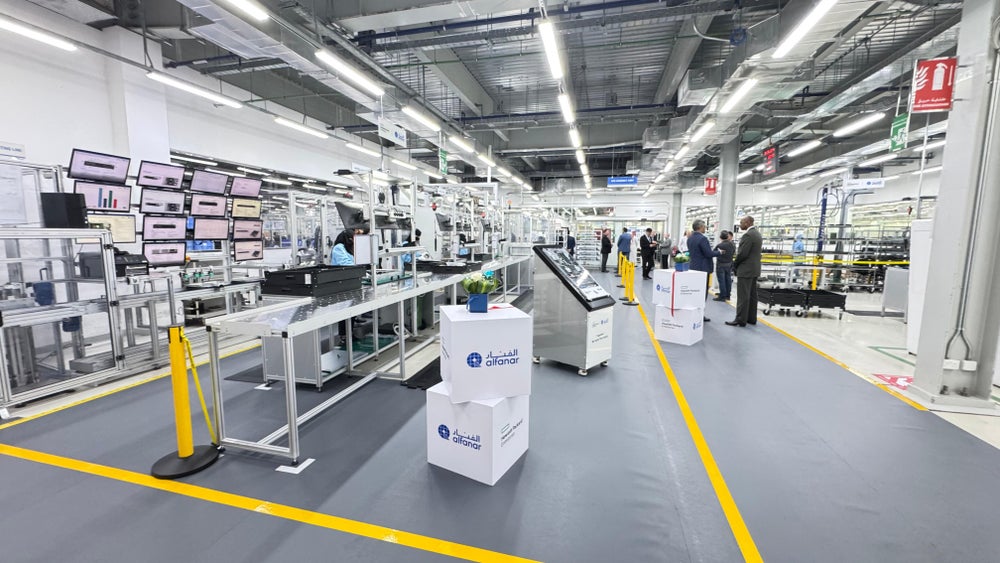 Image courtesy HPE
Since the initiative started in 2023, it has had a very positive impact on the ecosystem. For example, at the hardware level, we work with the leading chipset providers, now also including AMD processors. HPE's commitment attracts international partners, encourages investment in the Kingdom, and trains Saudi talent on advanced technologies.
At the product level, we started with compute products and are planning to expand into networking as announced at LEAP25. Other product lines are on our radar.
At the solution level, we are working closely with solution providers. During LEAP this year, for example, we announced a collaboration with Cohesity, providing their software on our platform and we received many requests for further integration and joint go-to-market engagements.
"In short, the impact goes far beyond just servers or boxes," Salah reiterates. "It strengthens the whole supply chain, attracts major global players to invest, and trains Saudi talent — creating a sustainable, growing tech ecosystem in the Kingdom."
With the expanded 'Saudi-Made' compute portfolio –comprising the aforementioned HPE ProLiant DL365 and DL385 Gen11 servers– the company aims to offer advanced security and performance, providing flexibility and speed to boost data analytics capabilities and generate real-time data insights. The HPE ProLiant servers carry the 'Saudi Tech' logo and are available in Saudi Arabia as well as Jordan, Egypt, and other Gulf nations.
"Driving HPE's continued investment of Saudi-based manufacturing of these servers, of course, is a mission to accelerate the Kingdom's ambition to become a global leader in data-driven economies and to reach key goals outlined in Saudi's Vision 2030. "I usually prefer to link what we are doing here to the Kingdom Digital Growth Strategy," Salah elaborates. "What we have done in Saudi Arabia supports many objectives of this strategy, but I want to focus on two: the digital economy and digital infrastructure. Why these two? Because when you build a resilient supply chain in Saudi Arabia, you avoid geopolitical issues affecting the supply chain; and can provide better delivery times. Consequently, you can support the digital economy by serving multiple sectors like telecom, oil and gas, smart cities, and giga/mega projects. By having this capability in the Kingdom, you support these sectors serving the digital economy and the broader Digital Growth Strategy. For digital infrastructure, the Kingdom aimed to upscale data center capacity to 6.6 GW by 2034 with a near-term milestone of 1.2 gigawatts in the coming years. All these data centers will need to be equipped with servers, and here Saudi Made competitive edge can be realized"
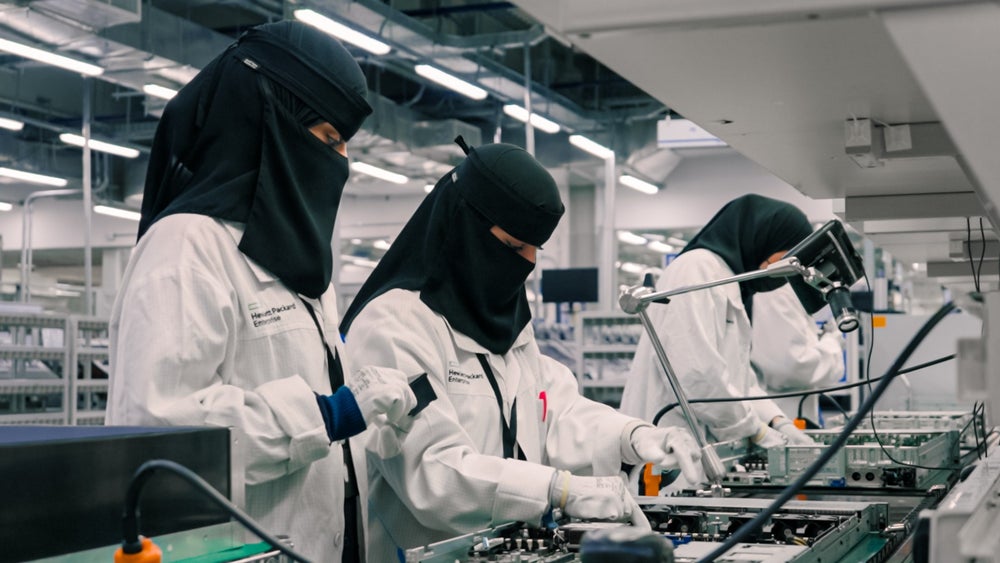 Image courtesy HPE
As part of the expansion, HPE and AMD will provide new training programs to further advance the skills of the Saudi workforce, while fostering innovation capabilities and accelerating the development of the Kingdom's technology ecosystem. "Innovation goes beyond invention," Salah says. "It's about solving real customer challenges in ways that create measurable impact. We view innovation through two lenses: closing gaps and creating new value.
To close a gap, imagine a customer facing soaring electricity costs or struggling with underutilized infrastructure. By delivering energy-efficient and cost-optimized systems, we help them reduce overhead while increasing performance. In the same way, if a customer is overwhelmed by massive volumes of unstructured data, we provide AI-ready infrastructure that makes it possible to manage, analyze, and extract insights at scale.
To create new value, we think about how customers can turn their infrastructure into a driver of growth. That might mean enabling AI-powered services, unlocking faster time-to-market for digital products, or helping government organizations and enterprises leverage their data securely in ways that strengthen the economy.
This is how we define innovation at HPE: addressing immediate customer pain points, unlocking the potential of emerging technologies like AI, and building solutions that convert challenges into opportunities for both our clients and the broader economy
Such an approach could also create a positive ripple effect among the smaller tech players within the Kingdom, Salah hopes. "Remember when I talked about the supply chain, the hardware, the product, and the solution? We started by bundling our platform with international solution providers like Cohesity," he says. "However, any small business or entrepreneur with their own application or software is more than welcome to partner with us, integrate their solution with our platform, and together we can jointly go to market as one bundled solution if they are willing to go the mile: building capabilities, transferring knowledge and empowering the broader ecosystem."
With the launch of the two new "Saudi-Made" servers for now, however, Salah says HPE's focus is on meeting the "huge domestic demand" and serving the surrounding region. "This is our main focus at the moment," he reiterates. "Regarding trends and future growth, as I mentioned before, we are expanding into networking products, we are taking a step-by-step approach to build the entire supply chain. This isn't something we can build all at once — it requires collaboration with our international and local partners and suppliers. We are growing this ecosystem gradually, step by step."